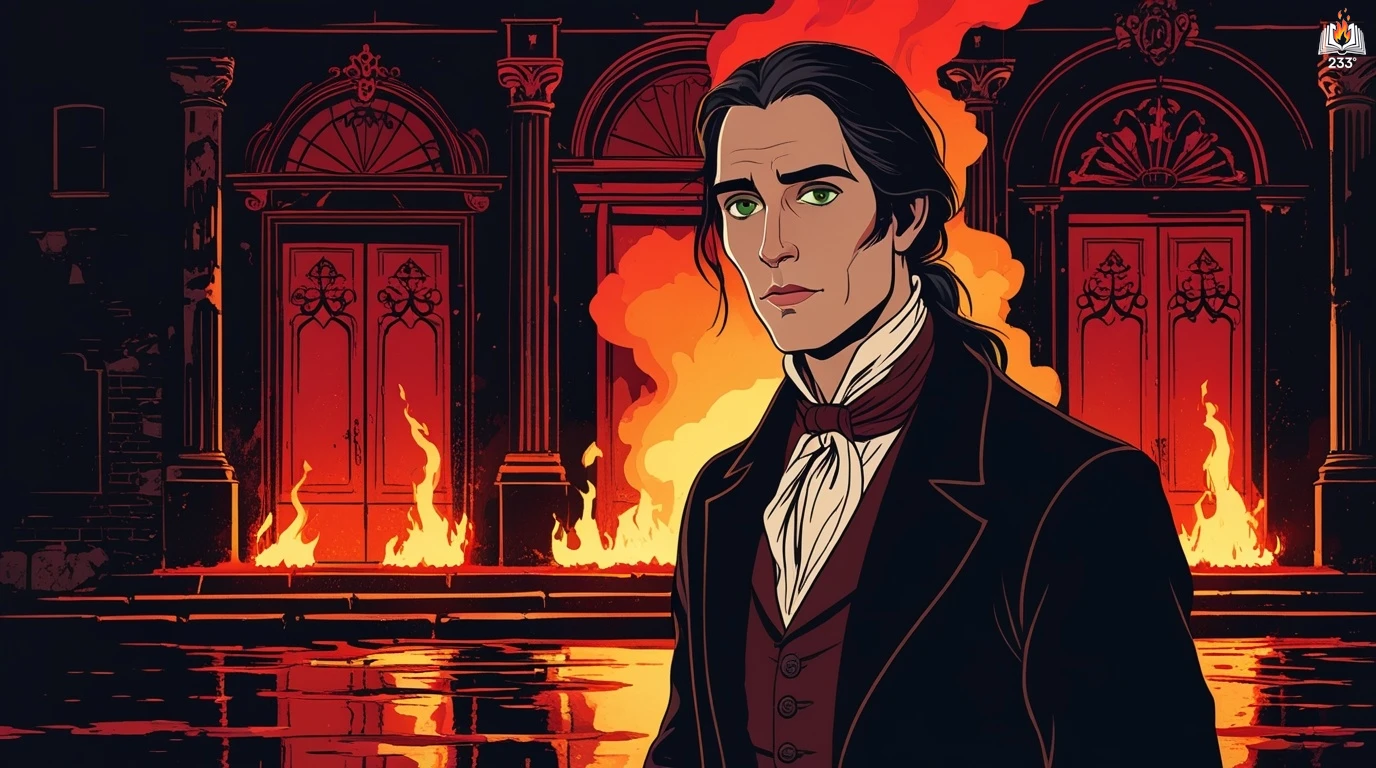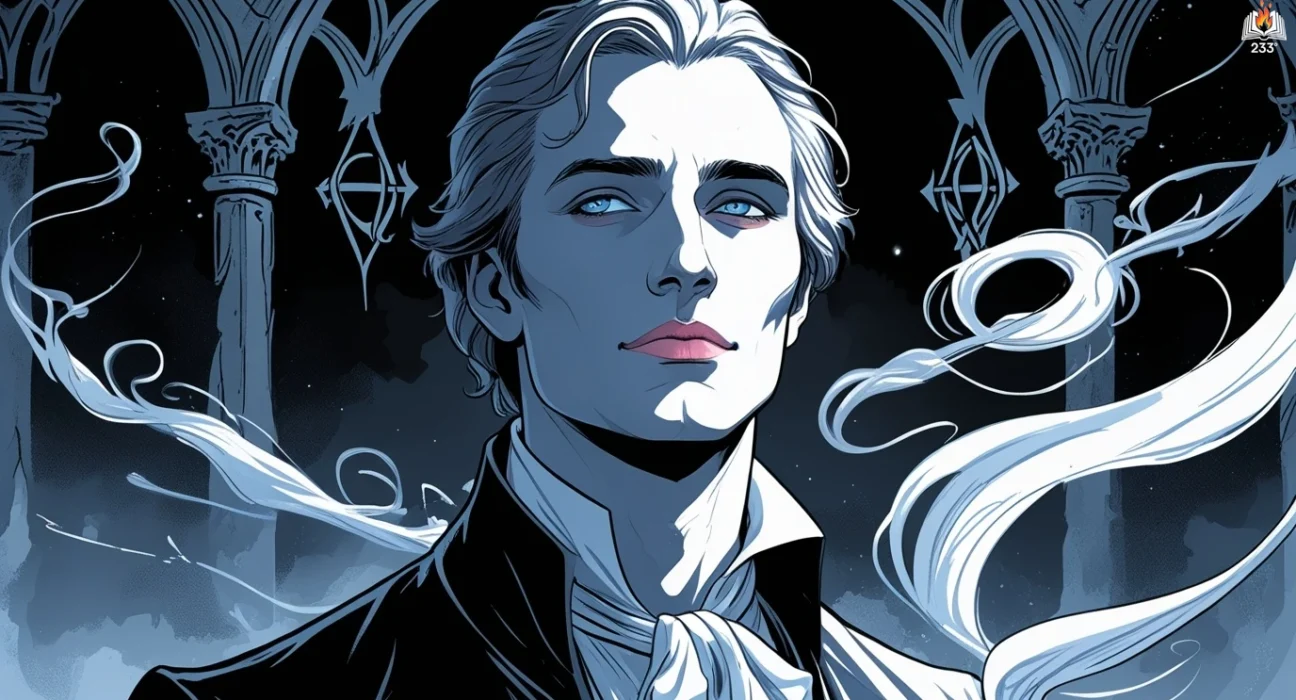
Prince Lestat by Anne Rice, published in 2014, marks the eleventh installment in The Vampire Chronicles, her legendary gothic saga that began with Interview with the Vampire in 1976. After years of silence, Rice resurrects her iconic protagonist, Lestat de Lioncourt, to navigate a vampire world in existential crisis. Vampires across the globe are being destroyed by an unseen force, an ancient voice compelling the strong to destroy the weak. Amidst this chaos, Lestat must decide whether to rise once again and lead his fractured tribe. The novel weaves myth, metaphysics, and legacy into a lush continuation of Rice’s rich vampire mythology.
Plot Summary
Darkness stirred. In the unseen corners of the Earth, vampires were burning, not by the hand of the sun, but from within – ancient ones, fledglings, innocents, and savages alike, reduced to cinders. A Voice, nameless and commanding, whispered through the psychic ether of the undead world, urging the strong to purge the weak, invoking an ancestral hunger for dominion and purification. And in the shadow of this creeping apocalypse, the one creature most capable of facing it remained silent – Lestat de Lioncourt, the Brat Prince of legend, hidden away in self-imposed exile.
Lestat, once the firebrand of his kind, lay dormant in the gloom of isolation, indifferent to beauty, weary of immortality, his soul dimmed by loss and centuries of introspection. Yet the Voice found him. It crept into his solitude like a dream half-remembered – pleading, commanding, tempting. It whispered of pain, of suffocation, of unbearable beauty lost to time. It addressed him by name. It knew his heart.
Elsewhere, the vampire world teetered. Young blood drinkers, leaderless and unchecked, multiplied without guidance. Their cities swelled with chaos. One among them, Benji Mahmoud, once a Bedouin child, now immortal and precociously wise, took to the airwaves. From his Upper East Side refuge, he broadcast into the ether a call for unity, for order, for their forsaken elders to rise. He named names – Lestat, Marius, Pandora, Maharet – and pleaded for them to return from silence and shepherd their crumbling tribe.
But Lestat had long since rejected the burdens of leadership, fleeing the noise and pleas, wandering through jungles, ruins, and deserts, seeking solace in decay. Only the Voice followed him, insistent and mysterious, speaking in tongues and weeping for beauty. One night, it appeared not only in his mind but in the mirror – wearing his face, mocking, mourning, a doppelgänger pressing against the glass. Lestat, unnerved yet intrigued, began to listen. The Voice professed love, a divine affection for him above all others, and bade him return to his roots – to France, to the ancestral chateau where once a mortal boy had dreamed of Paris.
While Lestat struggled with awakening, others dared to illuminate the night with reason. Fareed Bhansali, once a brilliant human physician, turned vampire by the ancient and reclusive Seth, brought science to the darkness. In laboratories cloaked beneath modern cities, Fareed dissected the mystery of the Blood – mapping genomes, testing biological reactions, questioning the sacred and the arcane. He viewed vampirism not as curse or miracle, but as mutation, evolution, a frontier ripe for understanding. With Seth’s support, Fareed sought to comprehend the very structure of immortality, even daring to build artificial eyes for the blind elder Maharet and offer speech to the mute Mekare.
In this new age of science and chaos, the center could not hold. The Voice grew louder. More vampires perished by invisible fire. Panic set in among the ancient ones, who had long slept through centuries unbothered. Some awakened in terror. Others prepared to fight. Lestat, pulled from his reverie, journeyed through this crumbling world, reaching out to the old guard – Marius the scholar, Armand the fanatic-turned-protector, Gregory and Everard and Sevraine, each a sovereign of their own domain. They gathered, reluctantly at first, in counsel, drawn not by loyalty but necessity. And always, the Voice lingered – cruel, persuasive, seductive.
At last, its secret unraveled. The Voice was not merely a presence. It was Amel – the spirit who had long ago fused with Queen Akasha, birthing the vampire race. When Akasha perished, her Sacred Core passed to Mekare, and through her, to all the undead. Amel had slumbered for millennia, locked in a silent prison of flesh, until Lestat’s music and rebellion stirred him awake. Now, weary of confinement, he sought escape – and incarnation.
To destroy Mekare was to destroy them all. Amel’s essence bound every vampire through invisible tendrils of blood. And yet, he was desperate to leave her, to be free. Lestat, ever the defiant lover of chaos, now faced an impossible choice – to reject Amel and risk annihilation, or accept him and become something entirely new. Through visions, dialogues, and pleas, Amel tempted him with promises of power, enlightenment, a destiny forged by fusion.
Lestat hesitated. He sought counsel in the quiet of old churches, in the warmth of music, in the haunted reflections of his past. He hunted across continents for his companions – Louis, his enduring sorrowful love, who now lived in graceful seclusion with Armand; David Talbot, the scholar-turned-vampire; even Maharet and Mekare, now spectral and fading. He yearned for a path untouched by tyranny or submission.
And yet, the world moved toward resolution. A conclave was called. At Trinity Gate in New York, in a hall gilded like a cathedral, the Children of Darkness assembled – old and new, fierce and frail, skeptical and devoted. There, Lestat stood before them, not as prince or messiah, but as voice and vessel. With Fareed’s blessing and scientific safeguards, with warnings and wisdom from Marius and Maharet, and the trembling trust of his kin, he made the unthinkable decision.
Amel would enter him.
In a ceremony veiled in ritual and dread, the Sacred Core was transferred. The world did not end. The fire stopped. The vampires who once trembled in fear now bowed before their new sovereign, not out of awe, but out of hope. Lestat, transformed and unchanged, accepted the burden of their future. He would not be a god. He would not be a tyrant. He would be a prince – of beauty, of rebellion, of endless responsibility.
Night fell again across the Earth, but the darkness had a pulse. And its rhythm belonged to Lestat.
Main Characters
Lestat de Lioncourt – Charismatic, rebellious, and theatrical, Lestat is both hero and anti-hero. His inner torment, longing for beauty and connection, and reluctance to lead are central to the narrative. Yet, his evolution from self-exiled wanderer to prince of the undead drives the story’s emotional and moral arc.
Benji Mahmoud – A preternaturally intelligent vampire turned in early adolescence, Benji serves as a voice of the new generation. With his vampire radio broadcast, he becomes a symbol of youthful unrest and communal yearning, urging the ancients to take responsibility for their progeny.
Fareed Bhansali – A brilliant human physician turned vampire by the ancient Seth. Fareed brings science and reason into the vampire realm, establishing laboratories and exploring the biological underpinnings of vampirism. His quest for understanding adds a modern layer to the mythos.
Seth – An ancient and enigmatic vampire with a healer’s soul, Seth avoids the politics of the undead world but supports Fareed’s mission. He represents the dignified, wise ancient who views vampirism as an evolutionary phenomenon rather than a curse.
Armand – A former zealot turned protector of his coven, Armand exerts strict control over Manhattan, offering sanctuary to his small, trusted circle. Once feared for his cruelty, he now embodies calculated compassion and order amidst growing chaos.
Louis de Pointe du Lac – The melancholic and philosophical vampire from Interview with the Vampire, Louis remains introspective and removed, yet loyal to those he loves. His quiet resilience contrasts Lestat’s dramatic impulses.
Amel (The Voice) – A disembodied, ancient presence haunting Lestat, Amel becomes the catalyst for much of the novel’s action. Mysterious and tortured, his desire for beauty and connection masks a force of immense power that once fused with Queen Akasha.
Theme
Legacy and Inheritance – The novel explores the burden and privilege of inheritance among immortals. Lestat’s lineage, both literal and ideological, becomes the framework for his decision to reenter the world and lead.
The Nature of Power – Power in Prince Lestat is both seductive and destructive. The novel scrutinizes its corruptibility, especially as Lestat contemplates whether to become a true ruler or continue his outsider role.
Loneliness and Connection – Immortality brings not joy, but alienation. Lestat’s yearning for kinship, Benji’s radio pleas, and even the Voice’s desperate need for companionship underscore the devastating solitude of the undead.
Science vs. Myth – Through characters like Fareed and Flannery, Rice probes the intersection of empirical understanding and mystical tradition. Vampirism is not merely mythic or spiritual but potentially scientific—a bold shift in the Chronicles.
Beauty and Despair – The pursuit of beauty, especially through art, music, and human experience, is a recurring motif. For Lestat, beauty is both salvation and curse—his inability to find meaning in beauty leads him to nihilism until he reclaims purpose.
Writing Style and Tone
Anne Rice’s writing in Prince Lestat is richly lyrical, drenched in gothic sensibility, and deeply introspective. Her prose moves with operatic intensity, often blending existential reflection with visceral horror. She structures the novel through a rotating cast of narrators, offering a mosaic of voices, each with distinct philosophical depth. Rice’s descriptive language elevates mundane settings into mythic landscapes and transforms inner turmoil into poetic revelation. Dialogues are stylized, and her characters often converse as if delivering soliloquies on stage, imbuing the novel with a theatrical resonance.
Rice’s tone oscillates between melancholic grandeur and intimate vulnerability. She crafts an atmosphere thick with longing, guilt, and revelation, allowing readers to feel both the weight of centuries and the rawness of personal grief. Even amid action or supernatural spectacle, the tone remains elegiac. Prince Lestat is a philosophical novel disguised as a vampire epic, and Rice’s meditative cadence ensures that the story’s emotional core—identity, belonging, and redemption—resonates long after the final page.
Quotes
Prince Lestat – Anne Rice (2014) Quotes
“Remember always,” he said, “that nothing is as precious to us as the magnificent gift of life. Let the moon and the stars always remind you of this—that though we are tiny creatures in this universe, we are filled with life.”
“We are not damned. We never were. Who under the sun has the right to damn any living breathing creature?”
“You are too strong for this rain and too strong for this sorrow.”
“Pain. Unspeakable pain. It didn’t matter who in this world or any other was staring at me, watching me, seeking to share this moment or merely shuddering as I experienced it. Just didn’t matter. Because in pain like this one is always alone.”
“we are blessed to be tiny beings in this universe. We are blessed to feel momentous because we are larger than these grains of sand.”
“Wisdom is strength. Collect yourself, whatever you are, into something with a purpose.’ ”
“Fear and music and blood and pain. That was still his existence.”
“Life is a gift. Immortality is a precious gift.”
“Only love could create such conflict, such longing, such fear.”
“I love you,” said the Voice. “Now, get up. Leave this place. You must. Get up. Start walking. This rain is not too cold for you. You are too strong for this rain and too strong for this sorrow. Come on, do as I tell you....” And I had.”
“I read her thoughts and I found the poetry inside of her, beneath the misfortune of warts and pockmarked skin, of hunched shoulders and deformed limbs. I loved her. Indeed she became, whole and entire, quite beautiful to me—. And she came to love me with her whole heart.”
“We seek to perfect what we are, not to constantly alter it. We seek to find something that is a true expression of our soul with which to shape what makes up our form. But there’s no need for you to trouble yourself over these things.”
“A silence fell between us. “I loved her, you know,” I said. “I loved her.” “Yes, I do know,” he said, “and, you see, I did not. And so this doesn’t matter to me very much. What matters much more is that I love you.”
“Those who desire power want to be immune to the power of others.”
“even if you make them, they’ll turn on you, rob you, betray you, and take off with someone else.”
“nothing is as precious to us as the magnificent gift of life. Let the moon and the stars always remind you of this—that though we are tiny creatures in this universe, we are filled with life.”
“But joy, the joy you’ve known, the love you’ve known, that is what matters, and we, the conscious ones, the ones who can grieve, only we can know joy.”
“And it is a great fact of history that the most mediocre and well-meaning imbeciles can strike down the mighty with surprising effectiveness when there is such a huge disparity of souls.”
“Give me the heartbeat. Give me the salt. Give me the Viaticum. Fill my mouth.”
“When it’s happening it is too beautiful, too overwhelming, and you can feel it’s being lost with every breath you take.”
“I’ve been passing through for the longest time.”
“She protected me. We had the souls of each other. We loved in some realm where the natural and the preternatural meant nothing.”
“Remember, Rose, whatever you’ve suffered, no matter how bad it’s been, you can use that, use that to be a stronger person.”
“Deep in my mind a thought did flash for a moment that one who commands must of necessity be wildly imperfect, boldly pragmatic, capable of compromises impossible for the truly wise and the truly good.”
“how many like Antoine were roaming the world, weak, afraid, without comrades or the consolation of love, clinging to existence as he did?”
“But we are blessed to be tiny beings in this universe. We are blessed to feel momentous because we are larger than these grains of sand.”
We hope this summary has sparked your interest and would appreciate you following Celsius 233 on social media:
There’s a treasure trove of other fascinating book summaries waiting for you. Check out our collection of stories that inspire, thrill, and provoke thought, just like this one by checking out the Book Shelf or the Library
Remember, while our summaries capture the essence, they can never replace the full experience of reading the book. If this summary intrigued you, consider diving into the complete story – buy the book and immerse yourself in the author’s original work.
If you want to request a book summary, click here.
When Saurabh is not working/watching football/reading books/traveling, you can reach him via Twitter/X, LinkedIn, or Threads
Restart reading!