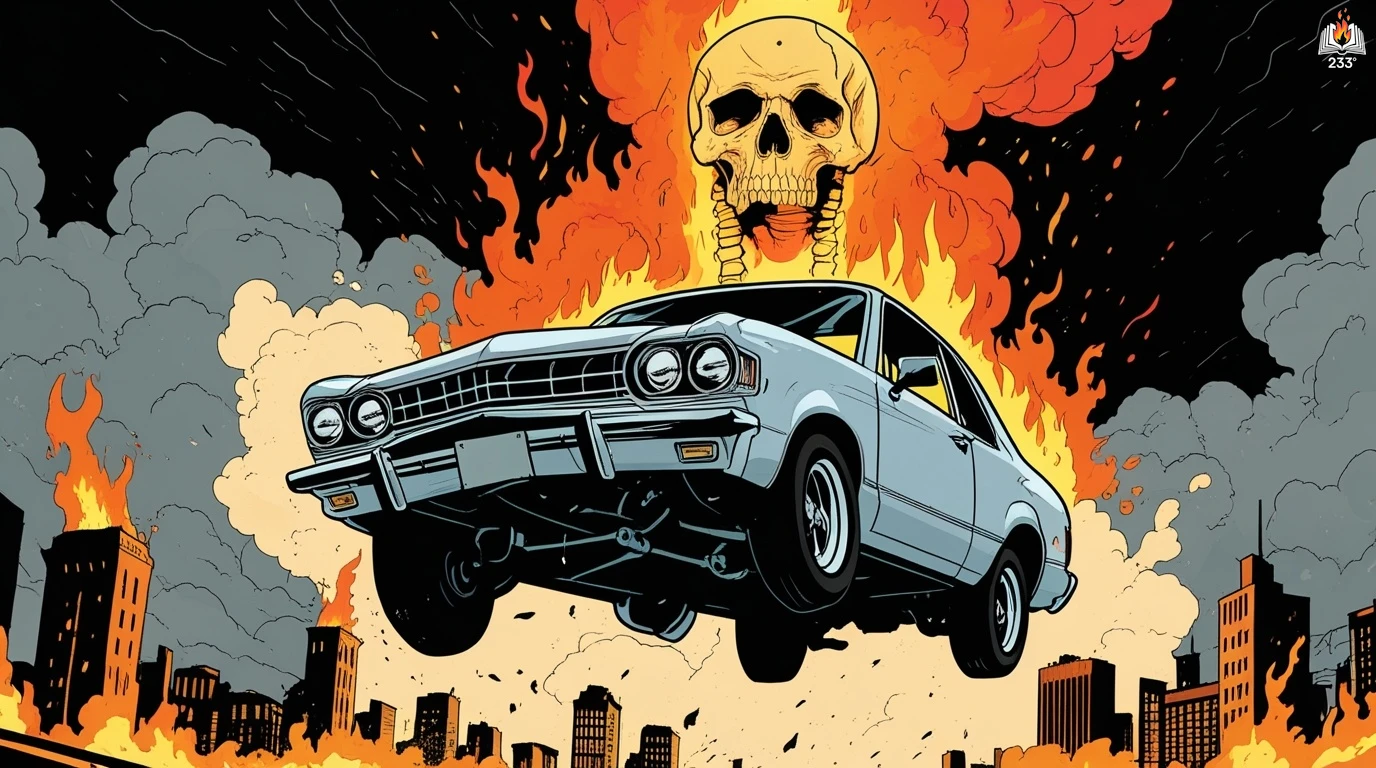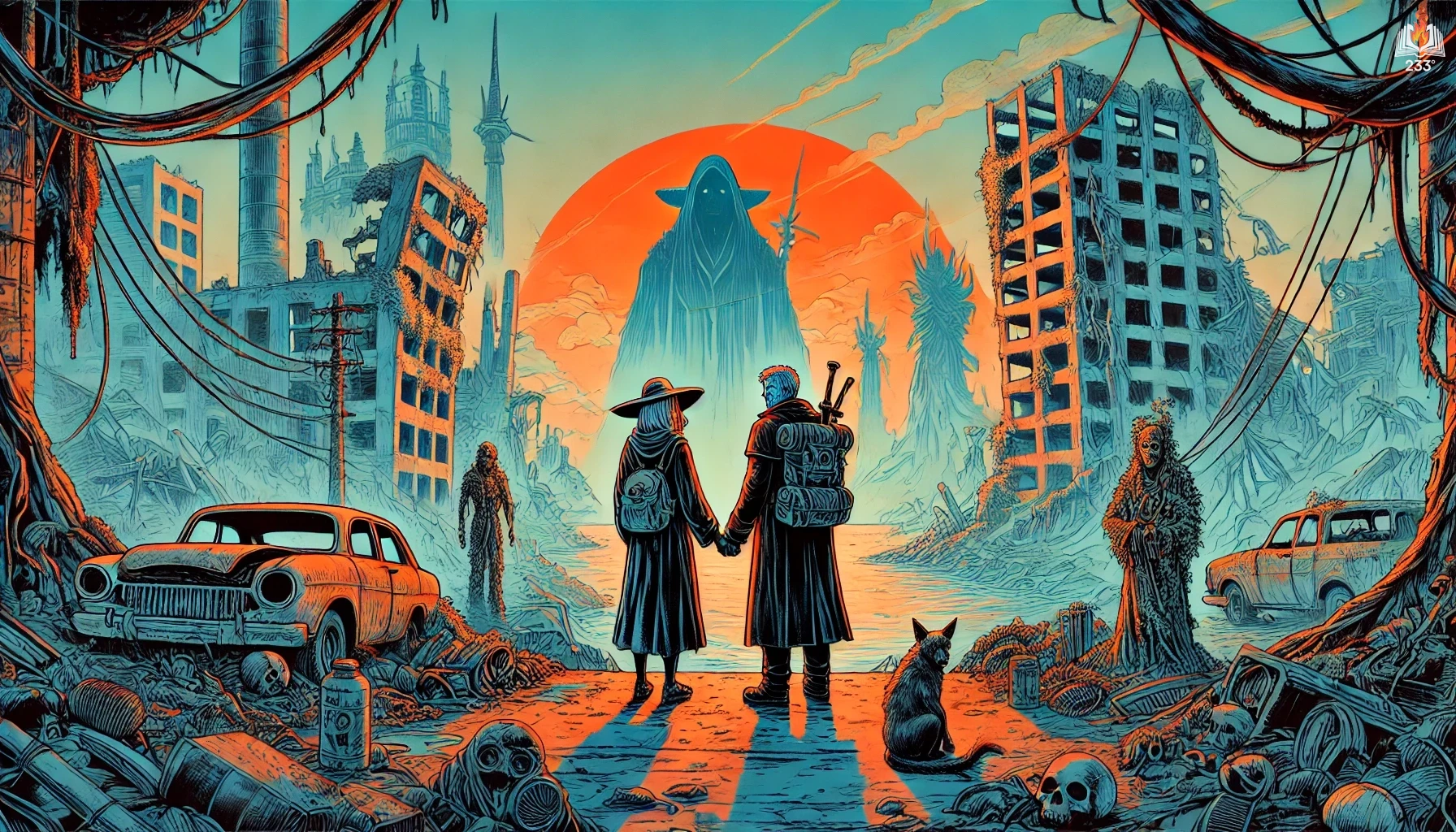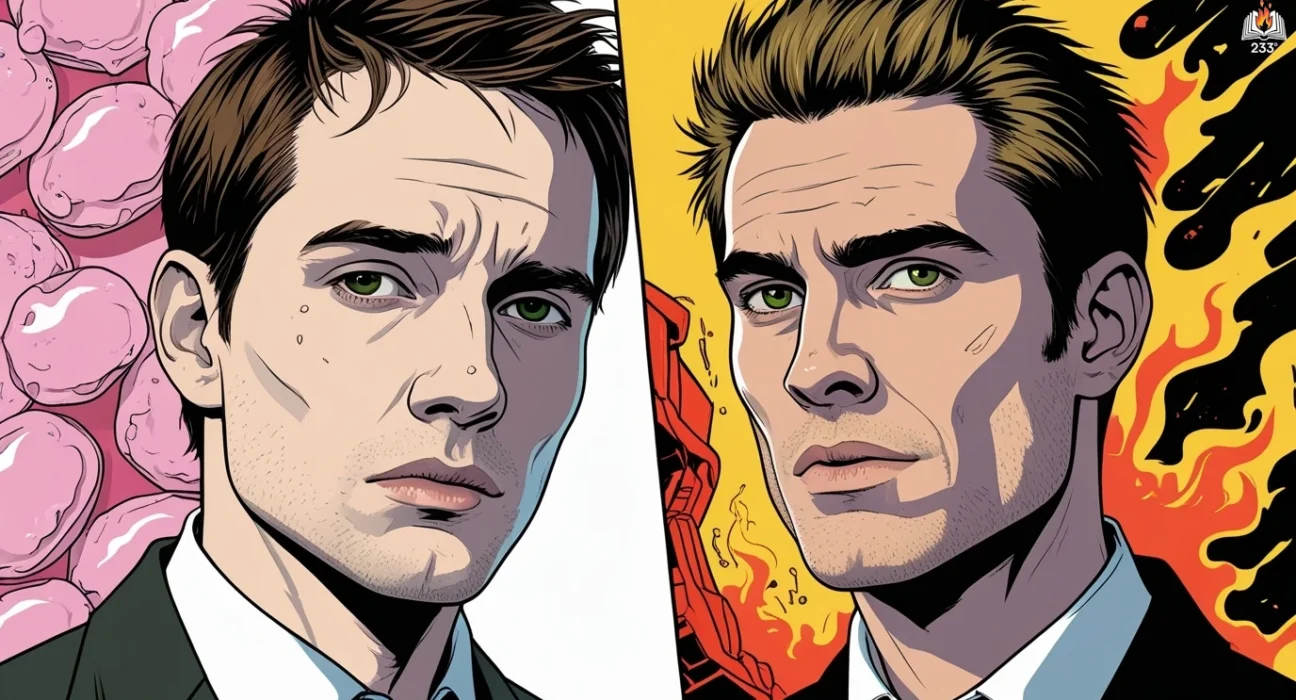
Fight Club by Chuck Palahniuk, first published in 1996, is a dark, visceral exploration of identity, masculinity, and modern disillusionment. Set in a nameless American city, the novel follows an insomniac narrator who finds catharsis and rebellion through underground fighting and a charismatic figure named Tyler Durden. Over time, this violent outlet evolves into a chaotic anti-corporate movement known as Project Mayhem. With its cult status and iconic film adaptation, Fight Club is a cornerstone of late 20th-century counterculture fiction.
Plot Summary
He was nameless. A voice in a cubicle. A body on an airplane. A man in a gray tie eating single-serving meals and watching other passengers with dull detachment. He counted time in airport terminals and insomnia-fueled hallucinations, drifting from one support group to another – testicular cancer, brain parasites, melanoma – each one a ritual of strangers clinging to each other for meaning. He didn’t belong, but in the arms of sobbing men, wrapped in the warm mass of Big Bob’s hormone-swollen chest, he could cry. And when he cried, he slept. Until Marla Singer showed up with her cigarettes and sideways stares. She was a tourist, another faker. She ruined everything.
Somewhere between insomnia and oblivion, he met Tyler Durden. Tyler was everything he wasn’t – fearless, magnetic, unfiltered. Tyler made soap from human fat and talked about destruction like it was an art. They drank together, bruised each other in a parking lot, and in the pain, something shifted. One punch led to another, then another, and what began as a brawl between two men grew into something sacred and secret. Fight club.
They met in basements, in bar parking lots, in places where concrete swallowed screams. Rules were whispered and fists flew. No shirts, no shoes, just bone against bone, muscle against pavement. Strangers became brothers. Pain was proof of life. Men who felt invisible became something solid. Each hit rewrote who they were, peeling away layers of artificial comfort.
Tyler spoke of freedom, of shedding possessions and self. He tore through the narrator’s sterile life, pulling him into a dilapidated house on Paper Street – a rotting shell with no power, leaking ceilings, and rusted nails lurking in the floorboards. They lived in the wreckage and called it home. Everything broke there. Plumbing, memory, identity. But in the breaking, they were free.
Marla drifted in and out. She took pills and wore sadness like a second skin. She walked through traffic without flinching. She and Tyler collided behind closed doors, but when the narrator asked, Tyler denied it. Tyler was slipping into places the narrator couldn’t follow, whispering promises into Marla’s ear while building something darker beneath the surface.
Fight club wasn’t enough. Tyler wanted chaos. He wanted to erase the world. And so, Project Mayhem was born. The rules changed. Names were gone. Identity dissolved. Recruits shaved their heads and followed Tyler’s orders with militant precision. They blew up coffee shops, rewired city buildings, smeared corporate art with gasoline and spit. Mischief turned to arson, and loyalty became cult.
The narrator watched as men turned into space monkeys, blindly obeying Tyler’s anarchist gospel. They lived in bunkers and scrawled commandments on the walls. He tried to stop it, but no one would listen. Tyler was the prophet now, and he – he was just the echo.
Everything spiraled. One mission left Bob dead, a bullet through his head and his name turned into a battle cry. His real name was Robert Paulson. In death, they gave him identity. The narrator tried to dismantle it all, but Project Mayhem had metastasized, spreading through cities like a virus. Each attempt to stop it unraveled Tyler’s deeper plan.
Then came the realization, sudden and hollowing – Tyler wasn’t real.
He had been Tyler all along.
The insomnia, the blackouts, the strange phone calls and missing time – all Tyler. Tyler was the part of him that broke loose in the sleepless dark. The part that didn’t care. The part that wanted to watch the world burn. They had been sharing the same body, taking turns at the wheel, and now Tyler had all the keys.
He chased Tyler across cities, through airports and hotel lobbies, following clues left in soap factories and half-empty bunkers. But every place he arrived, Tyler had already been. Every man with a shaved head looked at him like a messiah. He screamed that Tyler was dead, but they only saluted.
Marla became his last tether. He brought her to a restaurant filled with Project Mayhem foot soldiers and begged them to keep her safe. She didn’t understand. How could she? The man she knew had vanished, replaced by someone fractured beyond repair. But she went.
And so he found himself on the roof of a skyscraper with Tyler’s voice snarling in his head, a gun in his hand, and ten minutes left before the building would fall. Explosives were set in the basement. The towers surrounding them were wired too. This wasn’t just destruction – it was erasure. Debt records gone. Credit history wiped clean. A financial zeroing.
Tyler wanted transcendence. He wanted to become a legend. But the narrator wanted peace. And in a final moment of clarity, he turned the gun not on Tyler, but on himself.
The shot didn’t kill him.
He lived.
Tyler was gone.
And in the sterile light of a hospital room, surrounded by nurses who called him sir and treated him like a patient instead of a prophet, he saw Marla walk in. She held his hand. She didn’t speak. There were sirens in the distance and fire outside the windows, and the world he tried to save or destroy was still spinning.
But she was there.
And that was enough.
Main Characters
The Narrator: An unnamed protagonist plagued by insomnia and a hollow existence shaped by consumerism and corporate monotony. Emotionally numbed and psychologically fragmented, his journey is marked by a desperate search for meaning, leading him into the orbit of Tyler Durden. His arc is one of psychological unravelling, identity crisis, and eventual confrontation with the darkest parts of himself.
Tyler Durden: A magnetic, anarchic visionary who represents everything the narrator secretly yearns to be – fearless, charismatic, and liberated from societal expectations. Tyler is the mastermind behind Fight Club and Project Mayhem, advocating for the destruction of capitalist structures. As the narrator’s alter ego, Tyler embodies both seductive rebellion and terrifying nihilism.
Marla Singer: A morbid, chain-smoking woman who intrudes upon the narrator’s sanctuary of support groups. Marla is cynical, unpredictable, and emotionally raw, forming a tense and complicated love triangle with both the narrator and Tyler. She acts as a mirror and foil to the narrator, anchoring his reality even as she destabilizes it.
Robert “Bob” Paulson: A former bodybuilder suffering from testicular cancer, Bob is a tragic and tender presence in the support groups. His physical disfigurement and emotional openness make him a symbol of genuine vulnerability. His death becomes a pivotal moment in the narrative, catalyzing the escalation of Project Mayhem’s ideology.
Theme
Masculinity and Identity Crisis: The novel critiques the postmodern erosion of traditional masculinity. Through Fight Club, men reassert physical and emotional dominance in a society that has rendered them docile and directionless. The narrator’s psychological split reflects the deep conflict between societal expectation and primal instinct.
Consumerism and Alienation: Palahniuk satirizes the empty fulfillment offered by consumer culture. The narrator’s obsession with IKEA catalogs and designer goods highlights the absurdity of seeking identity through possessions, while Tyler’s philosophy demands freedom through destruction.
Duality and Dissociation: Central to the novel is the dual nature of self. The narrator and Tyler are two halves of a fractured identity, exposing the tension between civility and chaos, repression and desire. This theme plays out both internally and externally as the narrator confronts his own disintegration.
Rebellion and Anarchy: Project Mayhem represents the extreme reaction to societal control, pushing the narrative toward radical rebellion. Through acts of vandalism and terror, the group embodies Tyler’s belief in creative destruction – dismantling the old world to build a new one.
Death and Transcendence: Death is omnipresent, from cancer support groups to the looming collapse of skyscrapers. Palahniuk uses death not only as an end but as a path to clarity and transformation. Letting go, in the Tylerian sense, becomes a kind of rebirth.
Writing Style and Tone
Palahniuk’s writing in Fight Club is stark, clipped, and aggressively minimalistic. His sentences are often short and declarative, mimicking the thought patterns of someone spiraling into dissociation. The prose is rich with repetition and rhythmic mantras – “You are not your job,” “You are not your khakis” – which lend the narrative a hypnotic, cult-like cadence. This brutal efficiency serves to underscore the urgency and psychological fragmentation of the narrator’s world.
The tone is darkly ironic, cynical, and confrontational. Palahniuk balances existential despair with grim humor, allowing moments of absurdity to punctuate the bleakness. The narrator’s voice shifts between numb detachment and intense introspection, mirroring the instability of his psyche. Even the grotesque becomes oddly poetic, as the narrative embraces destruction as both a horror and a liberation.
Quotes
Fight Club – Chuck Palahniuk (1996) Quotes
“It's only after we've lost everything that we're free to do anything.”
“I don't want to die without any scars.”
“This is your life and its ending one moment at a time.”
“You are not your job, you're not how much money you have in the bank. You are not the car you drive. You're not the contents of your wallet. You are not your fucking khakis. You are all singing, all dancing crap of the world.”
“You know how they say you only hurt the ones you love? Well, it works both ways.”
“You are not special. You're not a beautiful and unique snowflake. You're the same decaying organic matter as everything else. We're all part of the same compost heap. We're all singing, all dancing crap of the world.”
“The things you used to own, now they own you.”
“Today is the sort of day where the sun only comes up to humiliate you.”
“Ok. You fuck me, then snub me. You love me, you hate me. You show me a sensitive side, then you turn into a total asshole. Is this a pretty accurate description of our relationship.”
“Only after disaster can we be resurrected. It's only after you've lost everything that you're free to do anything. Nothing is static, everything is evolving, everything is falling apart.”
“At the time, my life just seemed too complete, and maybe we have to break everything to make something better out of ourselves.”
“We've all been raised on television to believe that one day we'd all be millionaires, and movie gods, and rock stars. But we won't. And we're slowly learning that fact. And we're very, very pissed off.”
“If you don't know what you want," the doorman said, "you end up with a lot you don't.”
“I let go. Lost in oblivion. Dark and silent and complete. I found freedom. Losing all hope was freedom.”
“If I could wake up in a different place, at a different time, could I wake up as a different person?”
“It's not love or anything, but I think I like you, too.”
“The things you own end up owning you. It's only after you lose everything that you're free to do anything.”
“May I never be complete. May I never be content. May I never be perfect.”
“Maybe self-improvement isn't the answer, maybe self-destruction is the answer.”
“The lower you fall, the higher you'll fly.”
“I am Jack's complete lack of surprise. I am Jack's Broken Heart.”
“Everyone smiles with that invisible gun to their head.”
“Advertising has us chasing cars and clothes, working jobs we hate so we can buy shit we don't need.”
“We are not special. We are not crap or trash, either. We just are. We just are, and what happens just happens.”
“I wanted to destroy everything beautiful I'd never have.”
“The girl is infectious human waste, and she's confused and afraid to commit to the wrong thing and so she won't commit to anything.”
We hope this summary has sparked your interest and would appreciate you following Celsius 233 on social media:
There’s a treasure trove of other fascinating book summaries waiting for you. Check out our collection of stories that inspire, thrill, and provoke thought, just like this one by checking out the Book Shelf or the Library
Remember, while our summaries capture the essence, they can never replace the full experience of reading the book. If this summary intrigued you, consider diving into the complete story – buy the book and immerse yourself in the author’s original work.
If you want to request a book summary, click here.
When Saurabh is not working/watching football/reading books/traveling, you can reach him via Twitter/X, LinkedIn, or Threads
Restart reading!