The Autumn of the Patriarch by Gabriel García Márquez, first published in 1975, is a haunting and lyrical portrayal of absolute power and its isolating consequences. Set in an unnamed Caribbean country, this novel delves into the mythic life and symbolic death of a timeless dictator, crafting a baroque narrative that collapses historical boundaries and blends reality with hallucination. Renowned for its unbroken prose and poetic cadence, this novel stands as one of Márquez’s most experimental and politically charged works.
Plot Summary
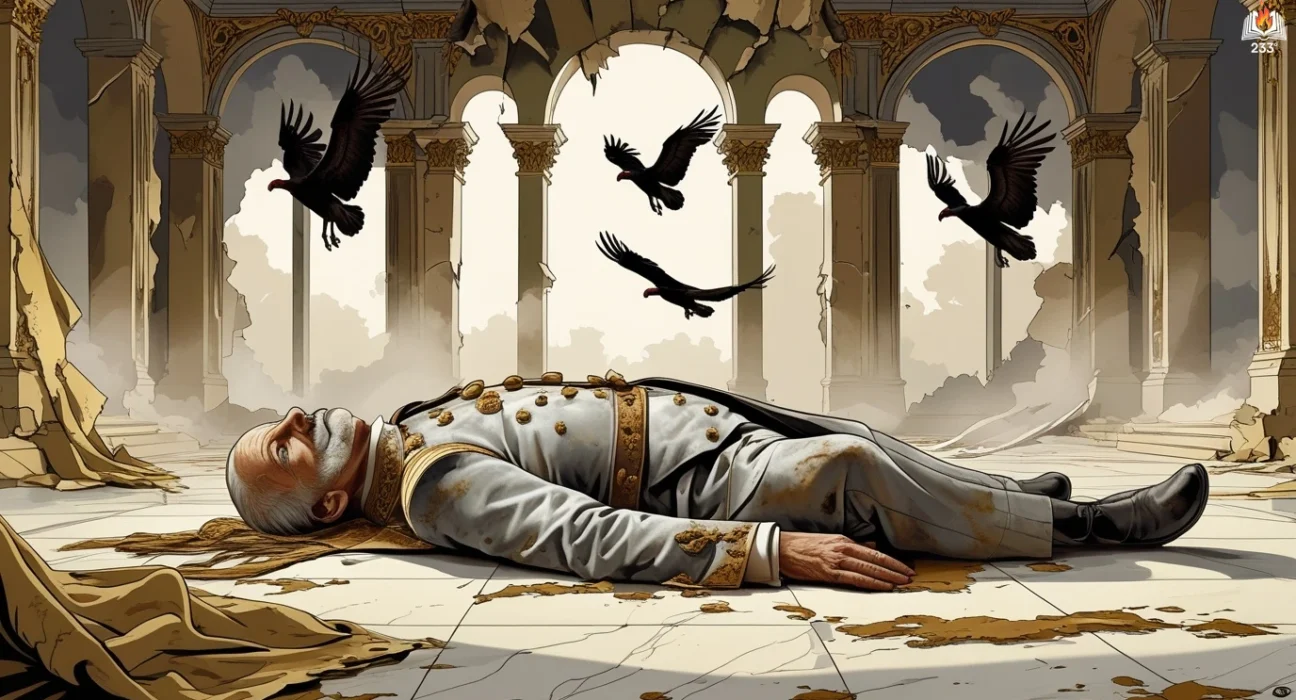
Over the course of a silent weekend, vultures circled the sky and breached the decaying shutters of the presidential palace. The people, long imprisoned by fear and superstition, dared to enter only when the scent of rot became undeniable, when the flapping of carrion wings revealed the death they had for generations been unable to confirm. Behind the armored doors, a kingdom of neglect unfolded – cows wandered through opera-curtained halls, concubines’ quarters lay in shambles, and beneath a cradle of dust and forgotten portraits, the despot of centuries lay face down in his denimed uniform, as ageless and unknown in death as he had been in life.
His face, though spared by the vultures, offered no recognition. No man had truly seen him, not in years, not through the parade of stamps, coins, or parades. His presence was a myth kept alive by flickers of candlelight and the illusion of command, and so, even in death, there lingered disbelief – for he had already died once before. That earlier death had proven false, a performance staged with the unwitting precision of dreams foretold in prophetic basins. In that time, his palace had become a marketplace of chaos and desire – barefoot orderlies dragging livestock, lepers pleading in rose beds, women birthing sons whose fathers could not be named. Power had been omnipresent, but it was scattered like confetti across a masquerade.
He had governed with voice and gesture alone, incapable of reading or writing, yet commanding the tides and eclipses with the certainty of a deity. The nation bowed to his whims – clocks chimed when he willed it, silence fell at the sound of his panting, and even his concubines, straddled in broad daylight, knew not to cry out but to whisper lullabies to the seven-month children who stared from the shadows.
But beneath this mirage of control lay duplicity. Patricio Aragonés, the perfect impostor, had emerged from obscurity to mirror the ruler so convincingly that their destinies became indistinguishable. He mimicked the walk, bore the hernia, grew deaf in the same ear, and shared the concubines with mechanical precision. He had no ambition – only the endurance to live another man’s life, to accept a kingdom of illusion for a salary and a pair of boots. Their shared dominion reached its absurdity when even children born of Aragonés bore the signs of paternity that could not be separated from the sovereign himself.
The general, protected by Rodrigo de Aguilar, had long stopped fearing coups or bullets. The armed forces were defanged by paranoia – fed blank cartridges and guarded more by suspicion than loyalty. He rode through the streets waving at faceless masses, his heart swelling at orchestrated shows of affection he believed were spontaneous. In lands where time had withered, peasants kissed his hand and sacrificed tapirs and yams for his passing train, for he was the patriarch of miracles, the eternal father of the nation.
On an afternoon that glistened with colored balloons and the scent of December rebellion, pamphlets rained from the sky calling for the death of tyranny. Amid the spectacle of revolt, he slipped through the city in silence while Aragonés lay dying from a poisoned dart. The impostor, spent and shaking, confessed his long-buried hatred, his exhaustion, his grief at being caged in borrowed flesh. As he died, he cursed the dictator not for what he had done, but for what he had made him become – a ghostly shadow of power without agency or affection.
The real man, now alone with his reflection, staged the death again – the denim, the gold spur, the familiar pose of sleep. The people believed it this time. The cathedral bells rang, fireworks burst, and the fishwife wept on the marble floor beside the body. He watched from the blinds as the city rejoiced, watched as his loyal widows led his cows into the streets, as the furniture of state was dismantled, and the flags of oppression were fed to fire. Even the seven-month runts danced with pots and pans, proclaiming freedom.
And still, he remained. He waited until the traitors gathered – generals, ministers, the primate, foreign envoys – all carving the future over coffee in the audience room. He slapped the table once, and panic scattered them like birds from a gunshot. Rodrigo de Aguilar gave the signal. Outside, bullets turned ambition into ash. The corpses of betrayal were carted off before dawn, and he ruled again, more alone than ever.
With no cabinet, no enemies, and no double, the burden of power pressed into his bones. He ruled with two ministers – one for health, one for handwriting. The rest, he claimed, was unnecessary. He reformed by fire – executed the torturers, dismantled the death chambers, and declared amnesty. He built stadiums and poetry contests to occupy the idle minds of the masses. He baptized children with his own hands. He swept the streets himself.
Birds came in cages from all corners, sent as jokes or offerings. He hung them in windows, the palace now a floating aviary. March winds carried their song across the marbled halls, and he believed it was peace. His physician said the buzzing in his ears was no longer sickness, but serenity.
And yet, within him, Aragonés’s final truths festered like a worm beneath the skin. He sought absolution in vengeance – interrogating those who had dragged his effigy, feeding men to crocodiles, flaying skin until confessions poured like blood. When he finally believed they had done it not out of hatred but for coin, he forgave them and signed their death orders with a sigh.
Then came the slow forgetting. The courtyard bloomed again with macaws and slogans. The people who wept at his death now rejoiced in his resurrection, convinced by spectacle and fear. His palace, reborn in grandeur, gleamed brighter than ever. The nation turned its gaze inward, grateful for order, indifferent to the cost.
And so he aged, haunted by silence. He no longer feared death – he feared anonymity. He ruled a country that needed him only as a symbol, no longer as a man. And in that twilight, surrounded by the birds, the banners, and the echoes of forgotten crimes, he drifted into a loneliness so profound that even history dared not record the hour of his true death.
Main Characters
The Patriarch (Unnamed Dictator): The central figure of the novel, the Patriarch is an ageless autocrat whose reign spans centuries. Portrayed as a blend of various Latin American dictators, he embodies the grotesque, tragic, and absurd extremes of power. His life is marked by paranoia, delusion, and isolation. Despite his omnipotence, he is pitifully human – yearning for maternal approval, haunted by mortality, and duped by those around him. His psychological decay reflects the rot of authoritarian rule.
Patricio Aragonés: The Patriarch’s official double, Aragonés is a reluctant impostor who sacrifices his identity and life to mirror the dictator. His gradual disillusionment and ultimate rebellion form a dark mirror to the Patriarch’s delusions of control. His death underscores the grotesque cost of loyalty and illusion.
General Rodrigo de Aguilar: A one-armed general, confidant, and ruthless executor of the Patriarch’s will, Rodrigo is both protector and enforcer. His loyalty is unquestioned, and his death triggers the Patriarch’s descent into greater isolation. His role exemplifies the militarization of governance and blind devotion to autocracy.
Bendición Alvarado: The Patriarch’s mother, Bendición exerts profound emotional influence over him, representing the one true human connection in his otherwise detached life. Even in death, her memory haunts him, blending maternal reverence with guilt and longing.
The Concubines and Children: A multitude of nameless women and illegitimate children populate the Patriarch’s household. They serve as emblems of his sexual exploitation and inability to foster genuine familial bonds. Their presence amplifies the despot’s detachment and the disintegration of lineage.
Theme
Absolute Power and Corruption: The novel presents a chilling meditation on the effects of unchecked power. The Patriarch’s reign is eternal, his will unchallenged, yet his authority breeds decay rather than order. Power isolates him from reality and turns his rule into farce and tragedy.
Decay and Death: From rotting palaces to vulture-filled skies, Márquez immerses the reader in an atmosphere of decomposition. The Patriarch’s gradual death, both physical and symbolic, mirrors the deterioration of his regime and moral legitimacy.
Time and Immortality: Time is fragmented and cyclical, creating a sense of eternal repetition. The dictator appears to die more than once, challenging linear chronology. This motif reinforces the timeless nature of tyranny and the futility of history under repression.
Illusion and Identity: The Patriarch’s use of doubles, orchestrated displays of love, and manipulation of public perception blur the line between reality and theater. The novel interrogates the very notion of truth in a society built on fear and fabrication.
Motherhood and Longing: The Patriarch’s fixation on his mother exposes his vulnerability. Her maternal scolding, in contrast to his unquestioned public dominance, reflects his arrested emotional development and the personal emptiness at the heart of his power.
Writing Style and Tone
Gabriel García Márquez employs a dense, lyrical, and stream-of-consciousness prose style that eschews traditional narrative structure. The novel is written in vast, paragraph-less blocks, mirroring the overwhelming and suffocating nature of the Patriarch’s rule. Márquez blends poetic language with grotesque imagery, creating a surreal and often claustrophobic reading experience. The deliberate lack of punctuation within long sentences forces the reader to navigate a textual maze, replicating the confusion and disorientation within the Patriarch’s mind and nation.
The tone is simultaneously majestic and macabre, evoking awe and revulsion. Márquez’s use of irony is pervasive – the grandeur of the dictator’s persona is undercut by the squalor and absurdity of his world. There is a mournful nostalgia for a paradise lost, but also a scathing critique of authoritarianism. The narrative voice slips fluidly between collective “we,” anonymous observers, and intimate interiority, dissolving the boundary between personal and political, witness and myth. This tonal hybridity intensifies the novel’s mythic resonance and political indictment.
Quotes
The Autumn of the Patriarch – Gabriel Garcia Marquez (1975) Quotes
“...the day shit is worth money, poor people will be born without an asshole”
“the bells of glory that announced to the world the good news that the uncountable time of eternity had come to an end”
“...as he discovered in the course of his uncountable years that a lie is more comfortable than doubt, more useful than love, more lasting than truth...”
“fear of death is the amber of happiness”
“...you'll see, he said, they'll go back to dividing everything up among the priests, the gringos and the rich, and nothing for the poor, naturally, because they've always been so fucked up that the day that shit is worth money, poor people will be born without an asshole...”
“and yet we didn’t believe it now that it was, and not because we really didn’t believe it but because we no longer wanted it to be true, we had ended up not understanding what would become of us without him, what would become of our lives after him,”
“with every six heads sixty enemies are produced and for every sixty six hundred are produced and then six thousand and then six million, the whole country, God damn it, we’ll never end,”
“they scrutinized the universe on the dial of the small radio through the interference of jeers from fugitive planets”
“our two postcard hearts were frightened in unison under the tenacious look of the unfathomable old man who kept on eating one banana after another”
“when after so many long years of sterile illusions he had begun to glimpse that one doesn’t live, God damn it, he lives through, he survives, one learns too late that even the broadest and most useful of lives only reach the point of learning how to live, he had learned of”
We hope this summary has sparked your interest and would appreciate you following Celsius 233 on social media:
There’s a treasure trove of other fascinating book summaries waiting for you. Check out our collection of stories that inspire, thrill, and provoke thought, just like this one by checking out the Book Shelf or the Library
Remember, while our summaries capture the essence, they can never replace the full experience of reading the book. If this summary intrigued you, consider diving into the complete story – buy the book and immerse yourself in the author’s original work.
If you want to request a book summary, click here.
When Saurabh is not working/watching football/reading books/traveling, you can reach him via Twitter/X, LinkedIn, or Threads
Restart reading!