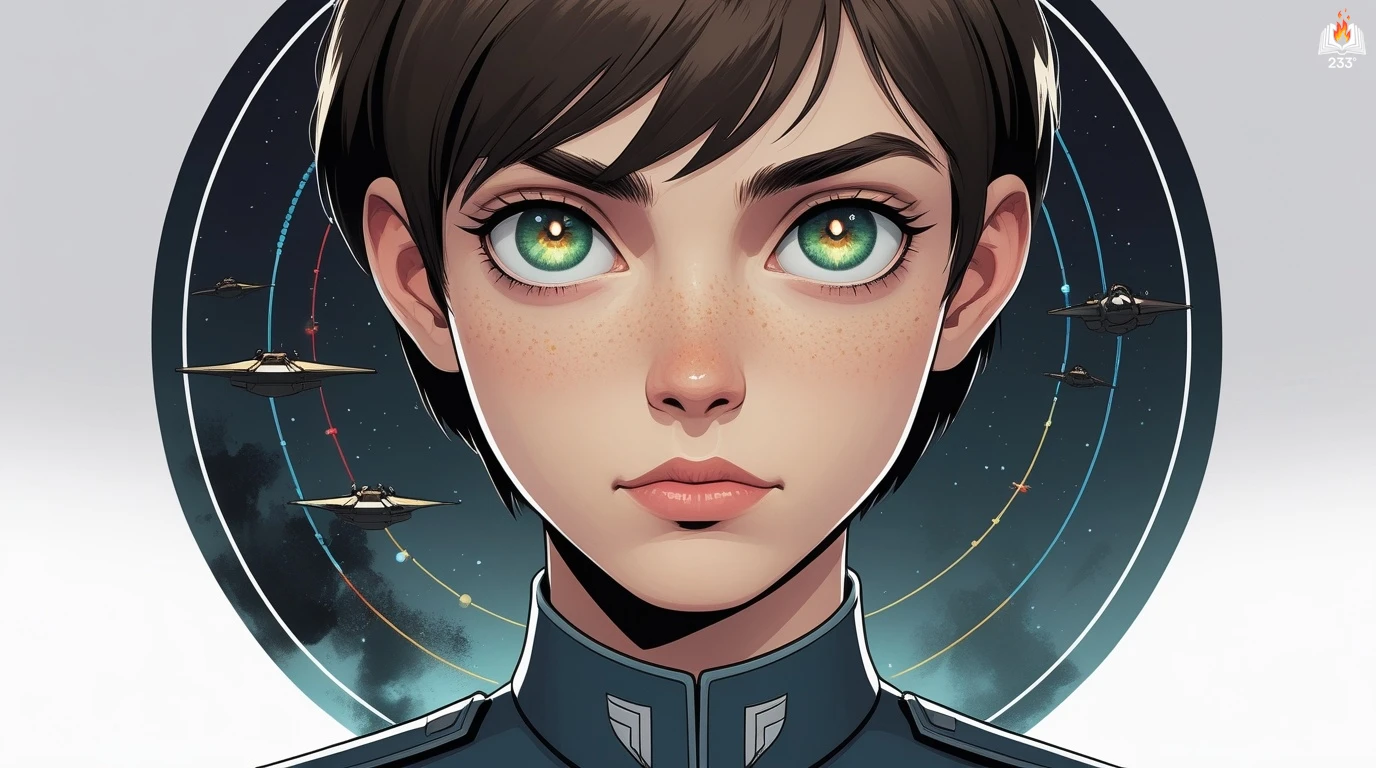
The Swarm (2016) by Orson Scott Card and Aaron Johnston marks the opening of the Second Formic War trilogy, set in the expansive and beloved universe of the Ender’s Game series. Taking place after humanity’s narrow survival in the First Formic War, the novel plunges into a fractured Earth struggling to unite against a returning alien threat. As political turmoil brews and the shadow of the Hive Queen looms larger, a handful of unlikely heroes must rise to prepare humankind for the greatest battle it has ever faced.
Plot Summary
The First Formic War left Earth scarred and trembling, its victory bought in blood and the desperate brilliance of Mazer Rackham and a few others who saw beyond politics and pride. Yet the quiet between wars was a fragile hush, and the stars above held no mercy. The Hive Queens, those masterful tacticians of alien will, had learned from defeat. Their vengeance now sailed across the void – vast, cold, and relentless.
Mazer Rackham, now stationed in orbit, was little more than a test subject in the bureaucratic maze of the International Fleet. Cramped inside a makeshift capsule disguised as space debris, he trained with his team for the day when debris would no longer be junk but soldiers’ graves. The Formics would not be caught unaware again. Mazer understood what few in command did: survival would demand not only courage but innovation, not only weapons but wisdom.
Far below, on the ravaged soil of China, twelve-year-old Bingwen threaded his small body through the labyrinthine tunnels the Formics had once burrowed through Earth’s skin. Where soldiers saw ruin, Bingwen saw patterns, opportunities, a map of alien thought. Though a child, his mind was sharp as any commander’s, and it was through his eyes that Captain Li, his cold and manipulative superior, sought to shape a new kind of soldier. Bingwen’s nights in the tunnels were a brutal dance with fear and resilience, his only solace found in quiet moments stealing data from military networks, slipping into the clandestine forums of soldiers like Mazer, offering insights under the cover of a false name.
In orbit, Mazer’s days blurred with drills and frustrations. His team – Rimas, the wry realist; Shambhani, the bright-eyed optimist; Kaufman, the hard-edged commando – moved like clockwork through simulations. But their cohesion was tested when word arrived that Copernicus, humanity’s most vital deep-space observatory, had been obliterated by a lone Formic scout. The news struck like a hammer blow, leaving the International Fleet scrambling to hold the facade of control. The political leaders, Hegemon Ukko Jukes chief among them, rushed to soothe a panicked world, but beneath their rehearsed calm ran an undercurrent of dread. Earth was now half-blind.
Bingwen, meanwhile, felt the noose of authority tighten around his life. His brilliance, once admired, had become a threat to those eager to remind a child of his place. When Captain Li set thugs from Bingwen’s own squadron against him in the tunnels, hoping to snuff out the boy who made grown soldiers look small, Bingwen’s ingenuity saved him. Using the same simulations meant to train him, he flooded the tunnels with the howling ghosts of Formic warriors, driving his would-be assassins into madness. But the victory left him bitter. To survive was no longer enough. To change the outcome of the war, Bingwen would need to rise higher.
Mazer, too, was forced to rise. As the swarm approached, the International Fleet’s weaknesses lay exposed: infighting, outdated strategies, and technological stagnation. But within his small team, Mazer kindled something rare – a spirit of innovation and camaraderie. Together, they devised the nanoshield, a cloud of smart nanobots capable of reshaping itself into a protective barrier, a tool that could turn the tide in brutal close-quarters combat against the Formics. The design, posted quietly in an underground military forum, sparked a wildfire of hope and debate across the scattered defenders of Earth.
Back on Luna, Mazer’s wife, Kim, labored in overcrowded hospitals, tending to the flood of refugees from the Belt. Her letters were a thin thread connecting Mazer to a world he could barely touch, a world of love and grief and stubborn faith. For every breakthrough Mazer’s team achieved, a shadow followed: the loss of trust in their leaders, the thinning edge of hope, the knowledge that this time, luck would not save them.
The Formic fighter that destroyed Copernicus was hunted down, vaporized by the Fleet in a public display of strength meant to calm the masses. But to the soldiers, it was a blunder. That wreckage might have held the key to the enemy’s new strategies. Instead, it was dust, and the Fleet’s commanders wore smiles as they stood atop ash. In the barracks, Mazer and his team watched the broadcasts with grim faces, their unspoken fears filling the room.
Bingwen’s rise was not without scars. After surviving Li’s assassination attempt, Bingwen delivered a masterstroke of leadership, assembling his squadron in the dead of night, shouldering punishment alongside them, demanding respect not through force but sacrifice. The boy commander became a symbol, a living rebuke to the cynics and careerists who saw only age and rank. Captain Li, always watching, marked the transformation with cold approval, knowing the boy he sought to break was becoming the weapon China, and perhaps Earth, needed most.
As the swarm approached, alliances frayed, and desperate bargains were struck. The Chinese military, long reluctant to commit forces to the International Fleet, finally offered soldiers – a gesture as much about survival as redemption. Bingwen was among those selected, though his youth would be hidden from the public eye. Variable Gravity, a secret training program in the Belt, waited for him – and there, amid the miners and marines, scientists and soldiers, the final line between extinction and endurance would be drawn.
Through it all, the specter of the Hive Queen loomed, vast and unseen, her intelligence woven through her warriors like nerve through flesh. Mazer, Bingwen, Victor Delgado the engineer, Ukko Jukes the embattled politician – each bore a fragment of the burden, a piece of humanity’s last, fragile wager. They prepared not for victory, but for survival, not for glory, but for the slim chance that somewhere, in the cold dark between stars, the human spirit might carve out a future from the jaws of annihilation.
Main Characters
Mazer Rackham: A brilliant but rebellious military officer whose firsthand experience fighting the Formics makes him indispensable. Mazer’s arc is defined by his frustration with bureaucratic inertia and his determination to innovate and prepare Earth’s defenses. His quiet leadership and practical genius make him a focal point of resistance.
Bingwen: A young Chinese prodigy whose keen intellect and battlefield instincts belie his age. Bingwen’s character is a blend of vulnerability and strength, embodying a deep sense of duty despite the moral compromises forced upon him. His development is marked by resilience in the face of betrayal and exploitation.
Victor Delgado: A skilled engineer and asteroid miner with firsthand experience surviving in space. Victor brings technical mastery and a no-nonsense attitude to the team, navigating not just physical challenges but also the political undercurrents threatening the war effort.
Ukko Jukes: The Hegemon of Earth, a political leader struggling to maintain a fragile planetary alliance. Ukko’s motivations oscillate between statesmanship and self-preservation, and his decisions have far-reaching consequences for the fate of humanity.
Captain Li: Bingwen’s commanding officer, a cold and manipulative figure who believes that cruelty shapes effective soldiers. Li’s methods test Bingwen’s limits, serving as a foil to Bingwen’s moral awakening.
Rimas, Shambhani, and Kaufman: Marines under Mazer’s command, each representing the soldiers drawn into this escalating conflict. Their banter, camaraderie, and sacrifices ground the larger stakes of the story in personal loss and human cost.
Theme
Unity vs. Division: The novel explores how political factions, national rivalries, and personal egos threaten the survival of the species. The failure to unify in the face of an existential threat becomes a chilling backdrop that amplifies the urgency of the protagonists’ work.
The Cost of Leadership: Both Mazer and Bingwen grapple with the burdens of command. The novel examines how leadership often demands painful decisions, self-sacrifice, and the endurance of moral ambiguity for the sake of a greater good.
Human Ingenuity and Adaptation: The development of new technologies like the nanoshield, the tactical use of miners in combat, and the merging of civilian and military expertise highlight humanity’s capacity for innovation when backed against a wall.
The Dehumanizing Nature of War: From the treatment of child soldiers to the cold calculus of military sacrifice, the novel underscores how war strips away innocence and reshapes identity, especially for young fighters like Bingwen.
Alien Otherness: The Formics, or “Buggers,” are portrayed as both a terrifying enemy and a deeply alien intelligence. Their biological and tactical differences challenge human assumptions and demand new forms of warfare.
Writing Style and Tone
Orson Scott Card and Aaron Johnston write in a propulsive, cinematic style, blending military science fiction with intimate character drama. The prose is accessible yet vivid, filled with immersive descriptions of zero-gravity combat, alien technology, and political intrigue. The authors balance large-scale action with smaller, emotionally charged moments, giving the narrative both scope and heart.
The tone oscillates between tense urgency and reflective melancholy. There’s a persistent undercurrent of dread as humanity braces for a seemingly inevitable invasion, but this is tempered by moments of humor, loyalty, and human connection, especially in the interactions between Mazer’s team and Bingwen’s inner struggle. Card and Johnston use alternating perspectives to enrich the emotional landscape, ensuring that readers feel both the personal and planetary stakes.
Quotes
The Swarm – Orson Scott Card (2016) Quotes
“You can’t alter your DNA and meet that expectation, so get over it. You are what you are.”
“A minor request," said Mazer. "Let's not refer to it as the training cage. 'Training' sounds laborious and regimented. Soldiers groan at the word. These men joined the IF to fight, sir. Let's call it the Battle Room.”
“He thinks I'm like him, Mazer realized. That's what we do as humans; it's how we read minds. We assume that other people think like we do. So if we're nasty and suspicious and conniving we assume that everyone is as nasty and suspicious and conniving as we are.”
“but this is the culture of China. There is no nation other than China, no society and traditions worth preserving other than those found in China, no people more important than the Chinese.”
“I had forgotten the first rule of diplomacy: Russians are never more cooperative than when they are about to betray you.”
“Why is it that the people who should be in authority are usually the people who don't want it, while the people who hold authority are usually the two-faced schemers who've stepped on people's backs to get it?”
“Then you’re hired, Lieutenant. I can abide a life outside the IF, but I can’t abide life without my wife’s stir-fry.”
“Russians are never more cooperative than when they are about to betray you.”
“Faith is not to blindly believe, son. Faith is action. It's doing something. It's creating what we need and believing that God will be merciful enough to grant it in his time.”
“Better to give the man what he wanted and save the objections for the battles worth fighting.”
“Those are experiences that have shaped you. Hard experiences. Painful even. But you are who you are because of them.” Other”
“The plant had likely been there for over a century, Wila knew, sprouting new petals every season and surrounding the temple with its pleasant perfume. So beautiful, she thought, and yet so resilient. Am I not stronger than a flower? She”
We hope this summary has sparked your interest and would appreciate you following Celsius 233 on social media:
There’s a treasure trove of other fascinating book summaries waiting for you. Check out our collection of stories that inspire, thrill, and provoke thought, just like this one by checking out the Book Shelf or the Library
Remember, while our summaries capture the essence, they can never replace the full experience of reading the book. If this summary intrigued you, consider diving into the complete story – buy the book and immerse yourself in the author’s original work.
If you want to request a book summary, click here.
When Saurabh is not working/watching football/reading books/traveling, you can reach him via Twitter/X, LinkedIn, or Threads
Restart reading!