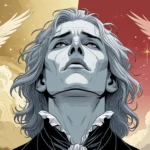
The Vampire Armand, written by Anne Rice and published in 1998, is the sixth installment in her iconic The Vampire Chronicles series. This novel delves into the life of Armand, one of Rice’s most enigmatic and tragic vampires, tracing his origins from the steppes of Eastern Europe through the grand decadence of Renaissance Venice and into his complicated relationships in the modern age. It is a tale of memory, loss, faith, sensuality, and the eternal yearning for redemption, recounted with Armand’s own confessional voice.
Plot Summary
In the shadowed stillness of a chapel where candles flickered against ancient stone, a young immortal stood over the slumbering figure of Lestat, unmoving as marble, untouched by time. Armand, born centuries before and reborn in blood, had come seeking something intangible – closure, perhaps, or solace. But finding none, he turned from the chapel’s hush and wandered upward, toward an attic haunted by rumor and the tattered memory of a murdered child. Around him, the convent, now a sanctuary for vampires, sighed with silence, broken only by the occasional whisper of footsteps or the faint echo of a forgotten hymn.
Memories swelled in him like the tide – of Marius, the refined, powerful one who had once been his salvation and his captor, and of the boy he had been before the world claimed him. In a convent soaked with history and sorrow, he longed to lie down beside the imagined ghost of a child, her clothes once discovered in the walls, her death a mystery left to time.
It was Marius who found him, stepping through the air with the quiet authority of ancient power. He spoke gently, always the gentleman, urging Armand to come away, to rest, to return to the mortal children he cherished – Benji and Sybelle. They waited for him in a house full of light and music, Sybelle’s fingers tracing Beethoven on the piano, Benji watching the world with dark, brilliant eyes. But Armand, still fractured, declined, claiming his sorrow needed solitude.
Soon after, David Talbot emerged – scholar, vampire, and something else altogether. He walked with human grace and supernatural command, his words probing, pressing, inviting Armand to tell his tale. And as though possessed by the weight of centuries, Armand did.
He began in the cold, wild lands near the steppes, where he was once a child called Andrei, stolen by raiders and dragged through the filth of Constantinople to be sold. Beaten, silenced, and wrapped in the frayed tunic of a brothel slave, he was paraded before buyers who mistook him for a girl – a treasure to be bought and defiled. There, under smoke-dark ceilings, amid the perfume of sin, he laughed for the first time in ages, mocking their ignorance, hiding his fear behind silence.
He was sold and carried on a ship through black seas. There, an old man cared for him with eerie gentleness, locking him in crimson silk and feeding him like livestock. When they reached Venice, the old man vanished, and Andrei – now called Amadeo – was thrown into another prison of flesh and want. He refused to eat, to speak, to bend. Slowly, he began to starve himself into the arms of death.
Then, one night, light broke through darkness in the form of a man clad in red velvet, with golden hair and hands of marble. Marius. A painter, a scholar, a keeper of ancient secrets. He lifted Amadeo out of misery, brought him into his opulent palazzo, and offered him warmth, education, beauty. With Marius, Amadeo bathed beneath painted ceilings, learned art and philosophy, and lived in a palace of decadent intellect and forbidden pleasures.
But Marius was more than a man – he was immortal. He fed on blood, and yet for years kept Amadeo mortal, waiting, watching, nurturing him into something worthy of the Dark Gift. The house became a sanctuary of boys, all protégés, all beloved, but it was Amadeo who became the favorite, the cherished. Their love blurred boundaries – carnal, paternal, possessive. And through this strange devotion, Amadeo flourished.
Until the fire came.
The Brotherhood of Satan, monks twisted by their own gospel, stormed the house. They dragged Marius away, burned his art, and destroyed the sanctuary. Amadeo, half-dead from the wounds of betrayal, was turned by another vampire – one of Marius’s enemies – and cast into a world he was not prepared for.
Years passed in chaos. He abandoned the name Amadeo and became Armand, leader of the Théâtre des Vampires in Paris, a cruel coven who fed on fear as much as blood. The light of Marius was extinguished in him. He fell into shadows, becoming something cold, calculating, devout in damnation.
But eternity is not still.
Centuries later, Lestat came – golden, defiant, filled with strange dreams of God and redemption. He brought with him Veronica’s Veil, a relic imprinted with the face of Christ, and told of journeys to Heaven and Hell. Armand scoffed, then believed, then crumbled beneath the weight of that belief. He stood in the sun, seeking death, seeking truth, and survived. In that moment, memory overwhelmed him, not in fragments, but in a flood – of grasslands, of a bundle he once carried meant for the trees, something holy lost to time.
In New Orleans, with Lestat comatose and the Veil casting silent judgment, Armand struggled to reconcile centuries of pain. He found love, not in the fire of immortality, but in the mortal souls of Benji and Sybelle. He guarded them, cherished them, gave them everything but his peace. They were light in the long night, reminders that something pure could still be held.
David pressed him to speak, to unburden himself into a book, a testament. At first, Armand resisted. But he found, in the telling, a shape to his torment. In words, he carved meaning out of memory. He dictated by candlelight, surrounded by the scents of spring and lace curtains still hanging from another’s dreams.
When the thirst came upon him again, he walked into the night with David at his heels. Through the humid streets of New Orleans, past blooming trees and peeling porches, he hunted. He found a wretched mortal soaked in filth and loathing and fed, not just on blood, but on the sick sweetness of power. It was not love. It was survival.
And when the man lay dead, Armand ripped the black hair from his scalp not out of need, but as ritual. Something primitive, something defiant. David watched, not with judgment, but with the weary patience of one who sees too much.
Back in the convent, David’s rooms were lit with candles, the air thick with the mingled scents of wax, lace, and old books. There, Armand began to speak in earnest, offering not a confession, but a requiem. Not just for himself, but for every lost child, every forgotten love, every flicker of divinity glimpsed in blood-soaked immortality.
And as the candle flames danced against the cypress walls, the music of Sybelle’s Appassionata echoed in Armand’s memory – a sonata for the dead, played for the living.
Main Characters
- Armand (Amadeo) – The protagonist and narrator, Armand is turned into a vampire at a young age by Marius and spends centuries struggling with his identity. Once a devout boy with artistic promise, he evolves into a conflicted, philosophical being torn between passion and damnation. His story is deeply introspective, exploring his trauma, his guilt, and his attempts to find love and meaning through faith, art, and connection.
- Marius de Romanus – Armand’s maker and mentor, Marius is an ancient vampire and painter who embraces Roman civilization and humanist ideals. He is a refined, moral being who sees beauty and value in human culture and tries to protect Armand from darkness. His love for Armand is genuine, though their relationship is fraught with control, devotion, and ideological clashes.
- Lestat de Lioncourt – Though mostly inert in the narrative (in a coma-like state), Lestat remains a looming spiritual presence. His celestial journey and possession of Veronica’s Veil indirectly inspire Armand’s internal crisis and quest for transcendence.
- David Talbot – A scholar and vampire chronicler, David encourages Armand to share his story. Their intellectual and emotional interactions serve as a frame for the novel. He becomes a provocateur and confidant, helping Armand articulate the painful truths of his past.
- Sybelle and Benji – Armand’s mortal companions. Sybelle is a beautiful, musically gifted woman who plays Beethoven’s Appassionata, while Benji is a precocious young Arab boy with a sharp intellect. They represent hope and connection for Armand, anchoring him in the present and offering the possibility of redemption through love.
Theme
- Immortality and Identity – Armand’s story is one of endless self-examination. His immortality becomes a prison of memory and existential crisis. As he recounts his life, he confronts his ever-changing sense of self – child, slave, artist, acolyte, monster – and the pain of never truly belonging.
- Faith and Redemption – A central theme is Armand’s struggle with faith. Raised in Eastern Orthodox Christianity and fascinated by Catholicism, he seeks solace in divine love, ultimately confronting religious icons like Veronica’s Veil. His yearning to find grace or damnation gives the novel a spiritual gravity.
- Love and Power – Throughout the story, Armand’s relationships oscillate between love and control. Marius’s love is both protective and possessive; Armand’s love for Sybelle and Benji is genuine but complicated by his vampiric nature. The balance between affection and domination is constantly tested.
- Art and Beauty – From Marius’s Roman house filled with classical paintings to Sybelle’s music, beauty serves as both salvation and temptation. Armand clings to beauty as a way to transcend suffering, but it also deepens his awareness of what he has lost.
- Trauma and Memory – Armand’s recollections are shaped by violence – sexual abuse, religious indoctrination, loss, and betrayal. His fragmented memories, some repressed, create a confessional tone that seeks to reconcile pain with understanding.
Writing Style and Tone
Anne Rice’s writing in The Vampire Armand is lush, lyrical, and deeply introspective. She constructs elaborate interior monologues that swirl with sensory details, metaphysical questioning, and eroticism. Her language is deliberately ornate, weaving together historical richness with philosophical and spiritual rumination. The narrative is fragmented by design, echoing Armand’s fractured psyche and reflecting the way trauma disrupts linear memory.
The tone is melancholic, meditative, and sometimes feverish. Rice balances gothic grandeur with emotional vulnerability, creating a mood that is at once romantic and tragic. Armand’s voice carries both the petulance of eternal youth and the weight of ancient sorrow. Through him, Rice explores the aching solitude of immortality and the compulsive search for connection. Her prose lingers, seduces, and wounds – befitting a novel that is more an operatic confession than a traditional vampire tale.
Quotes
The Vampire Armand – Anne Rice (1998) Quotes
“If I am an angel, paint me with black wings.”
“I know nothing, because I know too much, and understand not nearly enough and never will.”
“The human heart is my school.”
“Perhaps I fear him because I could love him again, and in loving him, I would come to need him, and in needing him, I would again be his faithful pupil in all things, only to discover that his patience for me is no substitute for the passion which long ago blazed in his eyes.”
“How can so much beauty hide such a bruised and steely heart, and why must I love him, why must I lean in my weariness upon his irresistible yet indomitable strength? Is he not the wizend funeral spirit of a dead man in a child's clothes?”
“And what if I never go of my own free will? Will you pitch me from some window so that I must fly or fall? Will you bolt all shutters after me? You had better, because I'll knock and knock and knock until I fall down dead. I'll have no wings that take me away from you.”
“Life is a tragedy, one way or another. What is certain is that you die.”
“I have it in my heart. It’s mine alone, this pain.”
“But remember the overall lesson, that your love for others, and their love for you, that the increase of love in life itself around you, is what matters.”
“If I'm an angel, paint me with black wings.”
“It is the very nature of this world that all things are devoured and time is a mouth as bloody as any other.”
“Perhaps the horror of my own life was that, no matter what I did or where I went, I always understood.”
“Good was above all kind; it was to be gentle. It was to waste nothing. It was to paint, to read, to study, to listen.”
“Please, Master, I can’t endure this,” I said. “Then, how will you endure eternity, my child? Don’t you know that’s what I mean to give you? What power under God is there that can break me?”
“Slowly, I brushed his hair more tenderly, and I saw to my own mute shock one of my tears fall right onto his face. It was red yet watery and transparent and it appeared to vanish as it moved down the curve of his cheekbone and into the natural hollow below.”
“Making him to be my mate, I made a mirror who saw me all the more clearly as a monster.”
“It seemed to me in my wild and passionate soul, in my newborn vampiric heart, that the Magi had come only for Christ’s birth but for my rebirth as well.”
“You think I’m a doll, don’t you? You think I’m cute and made of poured wax and you’ll stay as long as I stay.”
“What mattered now was only that I understood what it meant to cherish others and to cherish life itself. I”
“I’m trimmed in memories as if in old furs. I lift my arm and the sleeve of memory covers it.”
“All my life this love made meaningful, sparing nothing, and as I marveled at this, accepting it completely and without urgency or questioning, a miraculous process began. All my life came to me in the form of all those I had ever known.”
“I glanced back at the dead man on his side, his shoulder sagging. On the windowsill beyond and above him stood a blue glass bottle and in it was an orange flower. Isn’t that the damnedest thing?”
“Rape is unmanly.”
“Good was above all kind; it was to be gentle. It was to waste nothing. It was to paint, to read, to study, to listen, even to pray, though to whom I prayed I wasn’t sure, and it was to take every opportunity to be generous to those mortals whom I did not kill.”
We hope this summary has sparked your interest and would appreciate you following Celsius 233 on social media:
There’s a treasure trove of other fascinating book summaries waiting for you. Check out our collection of stories that inspire, thrill, and provoke thought, just like this one by checking out the Book Shelf or the Library
Remember, while our summaries capture the essence, they can never replace the full experience of reading the book. If this summary intrigued you, consider diving into the complete story – buy the book and immerse yourself in the author’s original work.
If you want to request a book summary, click here.
When Saurabh is not working/watching football/reading books/traveling, you can reach him via Twitter/X, LinkedIn, or Threads
Restart reading!