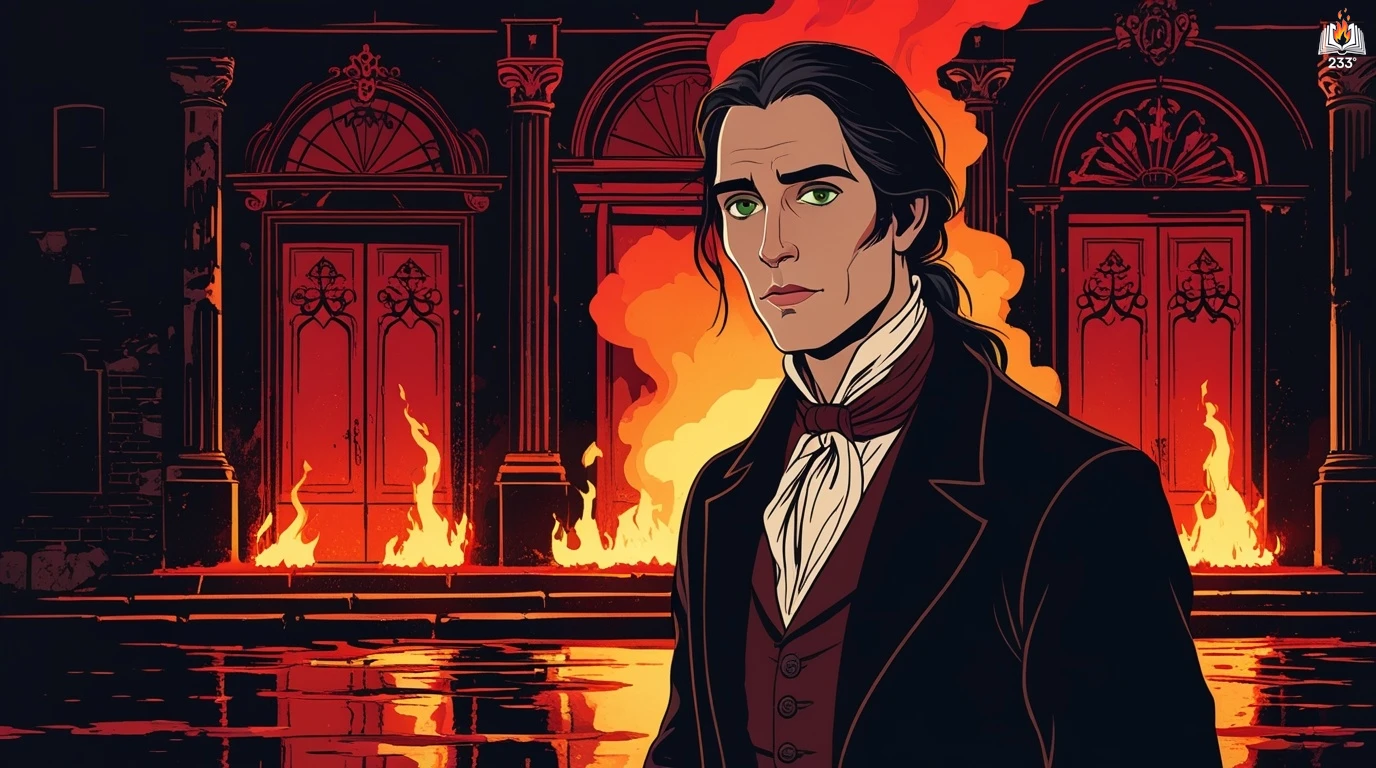


Blood and Gold by Anne Rice, published in 2001, is a richly layered entry in The Vampire Chronicles, her celebrated gothic series exploring the lives, loves, and agonies of immortals. This installment centers on the ancient vampire Marius, unfolding his millennia-long tale of survival, love, and despair through a conversation with Thorne, a Norse vampire awakening from centuries of self-imposed exile. Steeped in myth, history, and Rice’s lush prose, the novel delves deeply into the origins and legacies of immortal beings as they struggle to reconcile their eternal existence with the evolving world around them.
Plot Summary
In a world carved by time and shadow, where the living whisper of legends and the dead walk unnoticed among mortals, an ancient being stirs beneath layers of eternal frost. Thornevald – once a mortal warrior, now a forgotten vampire – slumbers in a cave encased in the arctic wastes. Dreams haunt his repose. He sees through the eyes of others, hears voices not his own, and feels the distant pull of those who share the Dark Gift. Among these visions, one burns brightest – a red-haired woman with bleeding eyes, the one who gave him the Blood, the one he cannot forget.
Whispers of catastrophe shudder through his dreams. A queen has risen, her heart aflame with power, her ambition as vast as the night. Akasha, the self-declared Queen of the Damned, begins her reign of terror, wielding fire to destroy her own kind. Blood drinkers perish by the hundreds, and through the clouded gift of his mind, Thorne watches their ends with silent despair. But amid the chaos, he sees her – his Maker – opposing the Queen, wielding strength and cunning to challenge the ancient force.
When Akasha falls, her Sacred Core passes into the hands of another – the Queen’s twin, Maharet’s long-lost sister. A balance is restored, and the web of connected souls flickers back into life. Yet Thorne cannot return to peace. His dreams churn with unresolved fury and a hunger for understanding. At last, sleep releases its grip. He rises from the ice and begins a slow journey south, his senses open, his heart aching for answers, his mind heavy with forgotten truths.
His path leads him to a city once ravaged by plague, now thriving with warmth and light. Amid cobbled streets and glowing windows, he finds The Werewolf – a tavern where blood drinkers gather. There, Thorne meets Marius – a being as old as empires, with golden hair and blue eyes that have seen centuries. Marius welcomes him not with suspicion, but with compassion. He sees the weariness in Thorne’s limbs, the storm behind his eyes, and offers sanctuary.
Marius takes him into his home, a haven of elegance and quiet magic, where ancient wood embraces modern light. There, Thorne bathes for the first time in centuries, cleansed not only in body but in spirit. In the warmth of the water, he begins to shed the burden of solitude. He eats no mortal food, but drinks deeply of memory, and finds within Marius a storyteller with his own wounds, his own longings.
Their conversation blooms over nights filled with firelight and ancient confessions. Marius speaks of his transformation from Roman senator to guardian of Those Who Must Be Kept – Akasha and Enkil, the original vampires. He tells of Pandora, his fierce and beautiful companion, and of his wanderings across the centuries in search of knowledge and art. Yet even he has known betrayal, has been brought low by his own kind, and carries a pain too deep for mortal language.
Together they feed – not on the innocent, but on the evil. Marius teaches Thorne the modern ways, the disguises and shadows vampires must now wear. They prowl through cities glittering with electric fire, taking blood only from those whose lives are stained with cruelty. And in the silence that follows the hunt, they return to words, to the past, to the stories that bind them both.
Marius’s companion, Daniel, lives in another world entirely. Once mortal, now immortal, Daniel has surrendered to obsession. In a chamber filled with miniature towns and railroads, he constructs a perfect, controllable universe, where time never changes and nothing dies. He barely speaks, but when he does, it is with the voice of one haunted. Daniel recognizes Thorne’s lineage, calling him child of Maharet, and with that name, Thorne’s rage surges again. His questions about his Maker – why she abandoned him, why she kept secrets, why she did not warn him of the Sacred Core – demand an answer.
Through Marius, Thorne begins to understand. Maharet is not merely his Maker, but the guardian of the Blood’s sacred thread, the preserver of history through her mortal descendants. She bore the burden of secrets too heavy to share. Her silence was not cruelty, but protection. Yet understanding does not soothe the fire in Thorne’s soul. His dreams still burn with chains – the strange bonds that once held Lestat, the vampire who defied death and sang the world’s truths. Those chains, spun from Maharet’s own hair and will, represent power beyond blood.
The nights stretch onward. In hushed chambers, Marius recalls the night when he was overthrown by a violent cabal of young blood drinkers, his body shattered, his sanctuary ruined. He tells of being saved by Pandora, only to lose her again to her own desires. Pain clings to him, and still he speaks, because silence is the deeper torment.
Thorne listens. He watches. His fury melts into sorrow, his longing into reflection. He realizes he must face Maharet, not with vengeance, but with the strength of one who has endured. He must ask, not accuse. He must become more than a forgotten warrior – he must become a bearer of memory, as she is.
He and Marius continue their path, moving through the night as ancient sentinels in a world too fast, too bright, too loud. But within them, the old gods whisper still. The thunder of Thor, the wisdom of Odin, the fire of Rome, the silence of Egypt – all live in the immortal blood.
And so the tale closes with a sense of quiet. Thorne, once lost in the snow, finds warmth not in fire, but in the companionship of one who listens, one who understands the weight of endless time. In Marius, he finds not only a friend, but a mirror – a fellow wanderer in the night. Their paths are not ended, only woven together now, like threads of blood and gold, glimmering in the darkness.
Main Characters
Marius de Romanus – A cultured, introspective Roman vampire who has lived for over two thousand years. A former senator turned scholar, Marius is both a caretaker of ancient vampire lore and a guardian of Those Who Must Be Kept, the original progenitors of the vampire race. His story is a personal odyssey of pain and enlightenment, marked by betrayals, forbidden love, and an enduring commitment to preserving vampire knowledge and civilization.
Thornevald (“Thorne”) – A Norse vampire awakened from an icy slumber, haunted by visions and memories of the cataclysmic events that changed vampire history. His yearning to understand these events and reconnect with his maker, Maharet, leads him to Marius. Thorne is both warrior and seeker, representing the struggle between vengeance and understanding.
Maharet – One of the ancient red-haired twin sisters and Thorne’s maker. Stoic, powerful, and tied to the origin of the vampire race, Maharet embodies both mystery and deep moral responsibility. Her silence and past decisions weigh heavily on Thorne, who questions her motives and loyalty.
Akasha (The Evil Queen) – Once the first vampire and self-proclaimed Queen of the Damned, she embodies domination and destruction. Her desire to remake the world leads to chaos and war among vampires, and her actions catalyze much of the trauma and fear within the narrative.
Lestat de Lioncourt – The charismatic and rebellious vampire who often serves as a catalyst within The Vampire Chronicles. Though not the protagonist here, Lestat’s revelations and dramatic interventions shape much of the recent vampire history, inspiring both awe and anger among his peers.
Daniel Molloy – Once a mortal interviewer, now a fragile, enthralled vampire, Daniel obsessively builds miniature cities in Marius’s home, a symbolic retreat from his complex reality. His childlike demeanor contrasts starkly with the epic experiences of the elder immortals.
Theme
Immortality and Isolation: The novel poignantly explores how eternal life breeds solitude, detachment, and longing. Characters like Marius and Thorne bear the weight of centuries, and their memories become both treasured and torturous, blurring the line between wisdom and weariness.
Myth and Memory: Rice draws deeply from ancient mythologies – Norse, Roman, Egyptian – to enrich her narrative. The vampires’ pasts are interwoven with human legend, and their stories unfold like sagas or epic poems. Memory, as both a source of identity and suffering, is a recurring force shaping every action.
Power and Responsibility: As custodians of immense power, Marius and others grapple with moral dilemmas. Should they intervene in mortal affairs or remain hidden? Should they protect their kind at all costs, or evolve beyond ancient laws? These questions underscore a constant tension between power and ethical restraint.
Love and Betrayal: Love, in Rice’s universe, is rarely simple. It is obsessive, spiritual, and often leads to betrayal. Marius’s relationships – with Pandora, Armand, and others – highlight the fragile nature of vampire bonds. Even love for humanity is tinged with possessiveness and tragedy.
The Search for Meaning: Despite their powers, Rice’s vampires crave purpose. Marius seeks solace in art and philosophy; Thorne in storytelling and vengeance; others in companionship or destruction. Their immortal quests mirror human existential dilemmas, magnified by the passage of centuries.
Writing Style and Tone
Anne Rice’s writing in Blood and Gold is opulent and introspective, marked by her signature baroque style. She weaves sentences that flow with lyrical beauty, often echoing classical storytelling. Her narrative unfolds like a confessional or philosophical soliloquy, drawing the reader into the richly imagined emotional and historical tapestries of her characters. The dialogue is elevated, often formal, reflective of the ancient beings who speak it.
Rice’s tone is both melancholic and romantic. She dwells in emotional nuance, embracing the gothic grandeur of her settings and the internal landscapes of her characters. Violence is rendered with poetic gravitas, and love is treated as a sacred, if perilous, force. Her use of multiple cultural and historical references imbues the novel with a timeless quality, anchoring the supernatural in deeply human fears and desires.
Quotes
Blood and Gold – Anne Rice (2001) Quotes
“Memo_ry was a curse, yes, he thought, but it was also the greatest gift. Because if you lost memory you lost everything.”
“I live lies because I cannot endure the weakness of anger, and I cannot admit the irrationality of love.”
“No matter how long we exist, we have our memories. Points in time which time itself cannot erase. Suffering may distort my backward glances, but even to suffering, some memories will yield nothing of their beauty or their splendor. Rather they remain as hard as gems.”
“Oh, the lies that I have told myself and others. I knew it yet I didn't know.”
“The fact that I loved you was the greatest lie I have ever lived.”
“Sleep is your friend. Dreams are your unwelcome guests.”
“....it was a brave man’s fear. I knew what he meant. What must a brave general feel when he knows the battle has gone against him and nothing remains but death?”
“Anger is too pathetic. Anger is as weak as fear.”
“Let my stories do what stories always do. Let them keep you from your darker dreams & from your darker journey. Let them keep you here.”
“Of course the moment I saw the books, I was overcome with pleasure. This always happens with me. I feel foolishly safe with books which can be a mistake.”
“And so this young one, this young one whom I had so loved, I had to forsake, no matter how broken my heart, no matter how lonely my soul, no matter how bruised my intellect and spirit.”
“There's a bitter cold in me, a cold which comes from a distant land. And nothing ever really makes it warm. You knew of this cold. You tried a thousand times to melt it, and transform it to something more brilliant, but you never succeeded.”
“Had I ever loved anyone more than I loved him? Had I ever revealed more of my soul to anyone than I had revealed to him? If my tears spilled now, he would see them. If I trembled now, he would know.”
“I find at moments I'm as fragile as glass.”
“You understood my soul, I thought, and now others are coming only to sack my heart of all its riches. What am I to do? We argued, yes, you and I, but it was with loving respect, was it not? I cannot endure without you. Please come to me, from wherever you are.”
“I wanted shelves for my books, and a finer chair for this desk. Of course there should be another library. What was a house to me if it did not possess a library?”
“I confided again that I wanted him, I wanted him to share my loneliness. I wanted him to share all that I could teach and give. Oh, the pain of it! All that I could teach and give.”
“Don’t make a religion of reason and logic. Because in the passage of time reason may fail you and when it does, you may find yourself taking refuge in madness.”
“The old gods will bring about vengeance not so much because they exist but because I once honored them.”
“Be wanderers through time, I said. Be witnesses of all splendid and beautiful things human. Be true immortals.”
“must somehow move to my restoration. I could not sink back in agony for that would breed but more agony. I must go on.”
“memory is desperate to leave us. Memory knows that we cannot endure its company. Memory would reduce us to fools.”
“And then the most evil idea came to me. The idea came to me unbidden as if there really were a Satan in the world and that Satan had come crawling along the stone floor towards me and put the idea in my mind.”
“Most strange and wondrous, I thought, that the power of the mind was greater than the power of the hands.”
“Lie quiet and you will lapse back into peace again. Be like the god Heimdall before the battle call, so still that you can hear the wool grow on the backs of sheep, and the grass grow far away in the lands where the snow melts.”
“I dream of miracles but I cannot imagine them. I pray for mercy, yet I cannot envision how it would come about.”
“An awareness had come over him that he wasn’t going to die. Loneliness in itself could not destroy him. Neglect was insufficient. And so he slept.”
“Ah forever!" I said. "I have such a love of that word, forever." "Yes, it is a timeless word," he said, raising his mossy eyebrows as he looked at me. "Time is ours, but forever belongs to God, don't you think?”
We hope this summary has sparked your interest and would appreciate you following Celsius 233 on social media:
There’s a treasure trove of other fascinating book summaries waiting for you. Check out our collection of stories that inspire, thrill, and provoke thought, just like this one by checking out the Book Shelf or the Library
Remember, while our summaries capture the essence, they can never replace the full experience of reading the book. If this summary intrigued you, consider diving into the complete story – buy the book and immerse yourself in the author’s original work.
If you want to request a book summary, click here.
When Saurabh is not working/watching football/reading books/traveling, you can reach him via Twitter/X, LinkedIn, or Threads
Restart reading!