

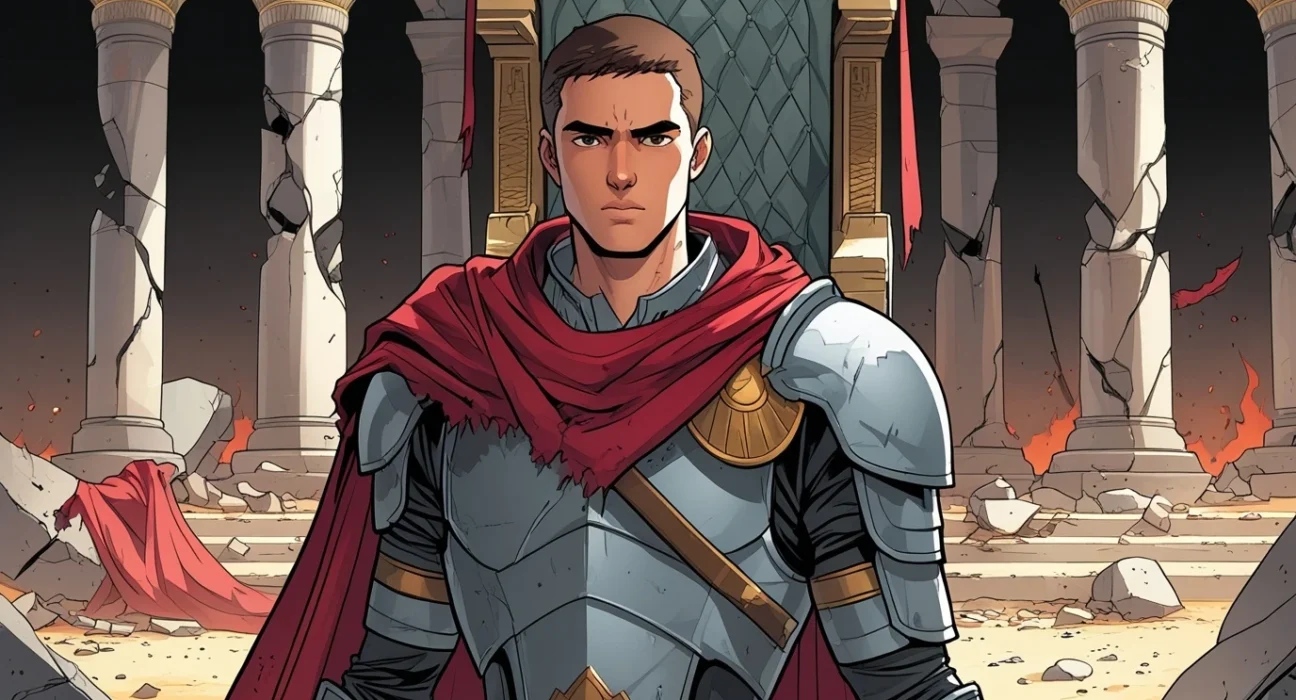
Infinity Blade: Awakening by Brandon Sanderson, published in 2011, is a novella set within the universe of the popular Infinity Blade video game series developed by ChAIR Entertainment. It bridges the story between Infinity Blade and Infinity Blade II, following the aftermath of a monumental confrontation. The story immerses readers in a richly imagined fantasy world where gods walk the earth, death is not the end, and a single blade holds the power to destroy immortals. At the heart of the story is Siris, a young warrior who achieves the impossible – he slays the God King. But his triumph marks only the beginning of a larger struggle, one that questions fate, identity, and freedom in a world ruled by the Deathless.
Plot Summary
In the cavernous depths of Drem’s Maw, a place where chains hung like spiderwebs from the stone sky and miners strapped themselves to the ceiling to harvest shimmering minerals, the impossible happened. A stranger arrived, cloaked and silent, wielding a blade every child knew by sight – the Infinity Blade, weapon of the God King. With swift and terrible grace, he cut down the daerils that oppressed the people and toppled Weallix, the self-proclaimed lord. Then, he pulled back his hood and helmet. Siris had returned – the Sacrifice who was never meant to win.
Generations had fed warriors into the maw of the Deathless, hoping not for victory, but for dignity. Siris, unlike those before him, had slain the God King. He returned home not as a martyr, but as a man reborn. Yet freedom did not come with cheers. The elders, once his patrons, now feared what he had done. They exiled him for the safety of the town. The other Deathless, they warned, would not suffer such defiance. Siris, bitter and unmoored, sought solace in the forested hut of his mother, Myan.
Myan had never wanted him to go to his death, nor did she revel in his survival if it meant further danger. But she fed him, listened, and reminded him that now, more than ever, he could shape his path. Siris considered retreat. The Infinity Blade was a curse. If he cast it away, maybe the Deathless would forget him. Maybe he could be free.
But the world offered no such kindness.
He set off again, traveling back to the castle where he had slain the God King. The towering black fortress seemed smaller now, but it held secrets he could not ignore. When he arrived, he found the daerils not hostile, but reverent. In killing their master, he had unwittingly become their new lord. The thought appalled him, but Siris used it. He ordered the daerils to gather and met with an ancient troll named Kuuth – blind, stooped, and thoughtful. Kuuth spoke of deadminds, soul-capturing dungeons, and a scattered pantheon of Deathless, each one cruel and powerful in their own right.
The throne held a mirror – not glass, but a machine powered by forgotten magic. It offered cryptic riddles and guarded knowledge behind passwords Siris did not know. Yet its presence confirmed what Kuuth had hinted at – the God King was only a piece of a much larger truth. The Deathless were not gods. They were something worse: immortal tyrants who had forgotten death, until Siris reminded them.
The peace of the ruined palace shattered when an assassin struck. Agile and wry, she mistook Siris for the God King, and her barbed crossbow nearly ended him. But when her poison failed, she fled. The real danger came behind her – two golems of thunder and steel, monstrosities that shattered stone with every step. Siris fought with shield and sword, reflex and training, but the monsters overwhelmed him. As he staggered, bleeding, he reached for the healing ring – and paid the price. The pain vanished, the poison burned away, but his hair grew long, his beard wild, his fingers gnarled. The ring stole time from his life with every use.
The assassin, quick to adapt, snatched the Infinity Blade from where it had fallen and vanished through the high windows. Siris, battered and humiliated, watched her flee with the one weapon that could kill gods. The daerils cowered in the shadows. Kuuth warned that they were all now targets, not just Siris, but every creature that had seen a mortal slay a Deathless. Their lives were forfeit.
Still, Kuuth spoke truths no one else could. The palace, he revealed, was never meant to be lived in. It was a lure, a beacon to draw in challengers so the God King could destroy them in ritual combat. Siris had been one more in a long line, a flicker of rebellion designed to be snuffed out. Yet he had succeeded. And in doing so, he had shattered the illusion.
The Infinity Blade, Kuuth said, was forged by the Worker of Secrets, a myth older than the Deathless themselves. It could slay immortals permanently, erasing even their souls. That knowledge, combined with the blade, was a threat none of the Pantheon would tolerate. Siris had not only drawn their wrath – he had declared war.
When Kuuth begged him to stay and learn the secrets of the deadminds, to make a stand from the God King’s seat, Siris refused. He could not win a war with two dozen daerils and a half-blind troll. He would travel north, seeking the Killer of Dreams, an enemy of the Pantheon who might be ally or prey. Either way, the path would lead him farther from Drem’s Maw, farther from his mother, farther from anything he had known.
Before he could leave, the throne room shook again. Another attack – not from the assassin this time, but from something worse. Siris fought once more, now truly alone, and the fight carved more years from his bones. Even as he bled and aged, the ring pulsed again, tempting him with another burst of false healing. But Siris understood the cost now. He would not live forever, nor would he try. He would not become what he had killed.
The path ahead was shadowed by gods and betrayals, monsters and machines. The Deathless would not forgive. They would not forget. And they would come.
But so would he.
Main Characters
- Siris – The protagonist and “Sacrifice,” Siris is a young warrior raised by his village for one sacred mission: to confront the God King. Against all odds, he defeats the tyrant, becoming a symbol of rebellion and triggering a cascade of consequences. Driven by a longing for freedom and identity, Siris is courageous, honorable, and burdened by a past he doesn’t fully understand. His journey evolves from survival to self-discovery, challenging the very myths of his existence.
- The God King (Raidriar) – A member of the Deathless, Raidriar is a calculating, authoritarian ruler who believes in order through dominance. After being slain by Siris, he is resurrected and begins unraveling the greater machinations at play. He is both terrifying and philosophical, a god-king who begins to suspect that he is a pawn in an even grander design.
- Myan (Siris’s mother) – Grounded, strong, and practical, Myan serves as an emotional anchor in Siris’s life. She offers both maternal love and sage advice, encouraging Siris to take charge of his destiny rather than live by others’ expectations. Her role, though supporting, underscores the emotional core of Siris’s humanity.
- Kuuth – A blind, elderly troll who once served the God King, Kuuth is surprisingly wise and philosophical. As an unexpected ally to Siris, he provides insights into the nature of the Deathless and the weapon known as the Infinity Blade. His history and demeanor challenge the stereotypical image of his monstrous race.
- The Assassin (Isa) – A cunning, sharp-witted woman with ambiguous motives, Isa initially attempts to assassinate Siris, mistaking him for the God King. Her quick-thinking, ruthlessness, and eventual interest in the Infinity Blade paint her as both a threat and a potential ally in the unfolding conflict.
Theme
- Rebellion and Legacy – The story explores the idea of inherited rebellion – Siris is the latest in a long line of “Sacrifices,” bred to challenge a tyrant no one expected to fall. This theme deepens as Siris questions whether he is bound by fate or free to forge a new identity, extending rebellion from action to ideology.
- Immortality and Deathlessness – Central to the plot is the concept of the Deathless – beings who cannot die unless slain by the Infinity Blade. The philosophical implications of immortality, such as stagnation, control, and the illusion of invincibility, are examined through both Siris and the resurrected God King.
- Identity and Self-Discovery – Siris’s victory sets him on a path not of conquest, but of introspection. What does it mean to live freely? Who is he without the role assigned to him by his village? These questions thread through his actions and decisions, driving him to seek answers beyond the sword.
- Control vs. Freedom – The tension between oppressive order and the chaos of freedom plays out both in the literal struggle against the Deathless and in Siris’s internal conflict. Even as others seek to control him—villagers, elders, ancient systems—Siris strives for liberation, not just for himself, but as a principle.
Writing Style and Tone
Brandon Sanderson’s writing in Infinity Blade: Awakening is swift, cinematic, and highly accessible. He crafts his prose with a balance of elegance and directness, capturing high-stakes combat and quiet introspection with equal deftness. Dialogue is sharp, often laced with subtle humor, and scenes move with a clear rhythm that reflects the novella’s origins in a dynamic, interactive world. There’s a strong emphasis on visual and physical descriptions—armor clinks, blades flash, and ancient halls echo—painting a world that feels both mythic and grounded.
The tone is an intricate weave of mythological grandeur and personal earnestness. While the narrative is steeped in the high fantasy tropes of ancient swords, tyrant gods, and mystical artifacts, Sanderson roots it in a deeply personal story. Siris’s voice remains sincere and unpretentious, often touching on regret, hope, and curiosity. The presence of futuristic terms like “deadminds” alongside traditional fantasy elements also adds a speculative, almost sci-fi edge to the tone, setting the story apart from conventional medieval epics.
Quotes
Awakening – Brandon Sanderson (2011) Quotes
“That was not a glare. That was a dignified look of measured contempt.”
“Surround yourself with people too afraid to speak, and you left yourself to only your own ideas. That could be disastrous. It was important to have men who would question you and see flaws in your plans, so long as you could control them. It was all about control.”
“Sometimes, continuing to breathe is a tough enough prospect”
“I told you that if you are going to do something, son. You need to do it with all of your heart. You have something you didn’t have before. Hope. You’ve defeated one of them. They can be beaten.”
“Nonsense. The sword is worth far more than that. I’ll throw in a pair of penis.”
“A rope could be a weapon, if you really needed one. Tie a heavy bit of metal to one end, then swing it about and attack.”
“Perhaps a greater kindness would have been to stay away.”
“Dozens had been sent over the centuries, always from the same family. A family sheltered, protected, and hidden by the people of the land.”
“Fenweed, a very healthy soup. A warrior’s soup. It tasted like dishwater.”
“fragment of”
“Surround yourself with people too afraid to speak, and you left yourself to only your own ideas. That could be disastrous. It was important to have men who would question you and see flaws in your plans, so long as you could control them.”
We hope this summary has sparked your interest and would appreciate you following Celsius 233 on social media:
There’s a treasure trove of other fascinating book summaries waiting for you. Check out our collection of stories that inspire, thrill, and provoke thought, just like this one by checking out the Book Shelf or the Library
Remember, while our summaries capture the essence, they can never replace the full experience of reading the book. If this summary intrigued you, consider diving into the complete story – buy the book and immerse yourself in the author’s original work.
If you want to request a book summary, click here.
When Saurabh is not working/watching football/reading books/traveling, you can reach him via Twitter/X, LinkedIn, or Threads
Restart reading!


