

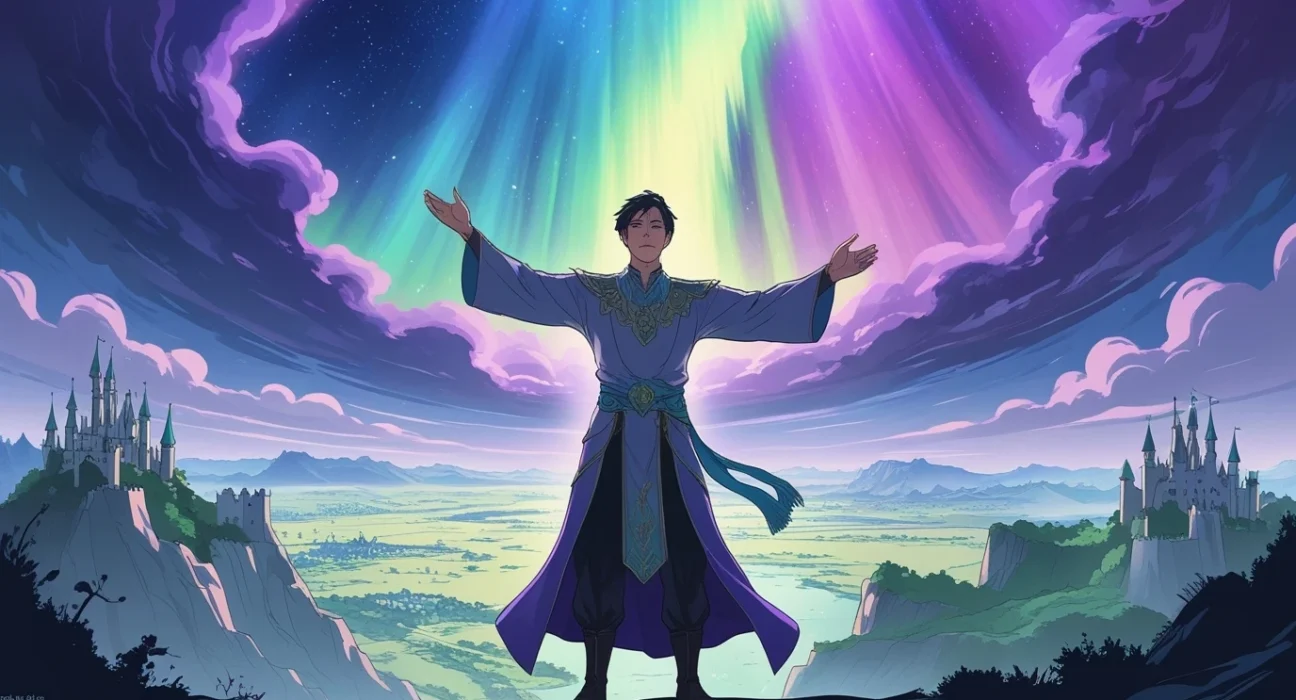
Perfect State by Brandon Sanderson, published in 2015, is a thought-provoking science fiction novella that examines identity, power, and reality through the lens of simulated worlds and posthuman technology. Set in a future where human consciousness is uploaded into personalized virtual environments called States, the story follows Emperor Kairominas, a Liveborn who rules over a magical fantasy realm. However, Kai’s carefully curated world is disrupted when the ruling body known as the Wode demands he fulfill a social obligation that brings him face-to-face with another Liveborn in a foreign State – an encounter that forces him to confront the truths behind his identity and the fabricated nature of his world.
Plot Summary
In a world forged from simulations, sculpted by a force known only as the Wode, Kairominas reigned as god-emperor. His domain was a perfect fantasy – kingdoms conquered, magic mastered, and storms calmed beneath a radiant celestial phenomenon called the Grand Aurora. Kai, a Liveborn, was not like the countless Simulated Entities that populated his world. He was one of the few real humans – his brain suspended in nutrient gel, his mind projected into a realm tailored to his every trait. Yet perfection was wearisome, and even omnipotence could dull. The Wode, arbiters of this artificial universe, offered him a new distraction. They required him to meet a woman.
It was not a request. Kai had known only two interruptions from the Wode in his centuries of rule: the revelation of the simulation at fifty, and now, the directive to procreate. He resented their intrusion, their control. Despite commanding entire continents, he could be summoned like a servant. Still, rules were immutable, and the Wode would reshape the very world around him to ensure obedience.
He traveled to a Communal State called Maltese – a simulated city locked in perpetual night, slick with rain and aglow with artificial stars. In this realm, Liveborn mingled and politicked, away from their own carefully tailored worlds. For someone like Kai, who had avoided other Liveborn, it was foreign ground. With him went only his mind and the remnants of abilities that lingered from his home – cognitive enhancements, healing protocols, and a stubborn pride.
His entrance into Maltese was explosive. A gunfight erupted, and Kai leapt into the fray with the instincts of a warrior-king. The weapons, he discovered, were mere toys – firing paint instead of bullets. A game, one said. Just another performance in a world built of illusions. To Kai, it felt like farce. To the others, it was Tuesday.
He was led to a restaurant atop one of the city’s towering spires, a place of glass and steel, far from the stone castles of his home. There, he met Sophie – his designated match, also a Liveborn. She wore red, walked like royalty, and smiled like someone who had given up on sincerity long ago. She called herself a president who sparked a war for the thrill of it, a disruptor of systems, and a skeptic of all meaning. Her wit clashed with Kai’s pomp, but something about her stirred the part of him that still doubted the perfection of his world.
Their conversation sliced into the heart of existence. Sophie spoke of the futility of accomplishments scripted by unseen architects, of how Machineborn feelings were no more real than the hum of electricity. Kai defended his kingdom, his magic, and the lives he had changed. But beneath his rebukes stirred agreement – a deep, uncomfortable truth that his triumphs were shackles made of silk. The Wode did not let Liveborn fail. Even death was merely delayed gratification.
Seeking escape, or perhaps authenticity, Kai led Sophie from the restaurant, up stairwells and past guards, to a rooftop overlooking the flickering skyline. There, with the rain hissing around them, they stood like relics – an emperor and an anarchist – voices lowered to whisper their rebellion into the dark. They shared histories, philosophies, fears. Sophie confessed that she only came because he’d been ranked lowest on the compatibility list. Kai admitted he was tired of being powerful but meaningless.
The air shimmered – a warning from Melhi, Kai’s nemesis. A fellow Liveborn, Melhi had once met Kai in a Border State, a neutral territory designed for competition between rulers. There, Melhi had shown signs of breaking free from the Wode’s narrative, pursuing not victory, but domination. His hacks crossed into forbidden territory, his thirst for vengeance more personal than strategic. Kai had thought it rivalry. Sophie suspected something worse – Melhi wasn’t playing the game anymore. He was rewriting it.
Even atop the rooftop, where the rain smeared makeup and muddled thoughts, the threat lingered. Kai tried to contact Besk, his eternally calm advisor. Silence answered. Perhaps the Wode had blocked him. Perhaps Melhi had. Whatever the reason, isolation pressed in.
But not loneliness.
Sophie stood beside him, raindrops tracing paths down her arms. She, too, had felt the hollowness of simulated grandeur. Her rebellion came in the form of chaos, war, unmaking. His had been conquest and creation. Yet here, beneath a sky programmed to drizzle, they both ached for something that could not be coded – meaning.
As they watched the city lights flicker like stars in a shallow sea, Kai realized he did not hate her. He admired her. She, unlike him, had stopped pretending. She didn’t deny the cage – she kicked at the bars. He, on the other hand, still polished them.
In that moment, the Wode’s grand design unraveled slightly, if only for them. The emperor and the rebel, neither wholly wrong, neither entirely right, leaned against a rusting railing and wondered what it would mean to live without permission.
A choice had been made. Perhaps not the one the Wode had predicted. But it was a real one.
Main Characters
- Kairominas (Kai) – The protagonist and Emperor of a magical fantasy realm, Kai is brilliant, proud, and immensely powerful within his own State. Born into a simulation tailored to his personality, he has conquered the world and mastered a form of magic known as Lancing. Though he thrives in his controlled environment, his arrogance masks a deeper insecurity about his purpose and the authenticity of his existence. His arc revolves around confronting the artificiality of his world and discovering the limitations of even godlike power.
- Shale – Kai’s loyal companion and bodyguard, Shale is a knightly figure clad in full armor, a remnant of Kai’s early adventures. He is fiercely protective and deeply human, despite being a Simulated Entity. His history with Kai is long and filled with shared battles, and he serves as both friend and reminder of Kai’s origins.
- Besk – The emperor’s chancellor and advisor, Besk is a stoic, efficient figure who often serves as the Wode’s mouthpiece. Despite his irritatingly unflappable demeanor, he’s integral to Kai’s administration and seems to understand the system of the States more intimately than he lets on. He represents the ever-present hand of the Wode and the rules that even emperors must follow.
- Sophie – A fellow Liveborn from a radically different simulation, Sophie is rebellious, cynical, and intellectually sharp. Coming from a State built around political and social upheaval, she challenges Kai’s perceptions of morality, meaning, and control. Her confrontation with Kai pushes him to reevaluate not just his duty, but his understanding of reality.
- Melhi – Kai’s nemesis and a fellow Liveborn ruler, Melhi is a hacker and saboteur from another State. Their rivalry manifests in border skirmishes and psychological warfare. He serves as a mirror and warning – the darker path of obsession and escalation that Kai could one day follow.
Theme
- Simulated Reality and Identity – At its core, the novella interrogates the nature of identity in a digitally constructed world. Each Liveborn lives in a simulation designed to mirror their ideal world, but this perfection leads to existential unrest. Kai’s confrontation with the artificiality of his world and the reality of his mind-in-a-jar existence explores what truly defines a person – experience, thought, or autonomy.
- Power and Control – Kai’s rise to power within his own State represents absolute control, yet the intrusion of the Wode reveals the illusion of that control. The story scrutinizes the fragility of perceived dominance, questioning whether power holds meaning when it is granted, regulated, or confined by external systems.
- Freedom vs. Determinism – The story explores whether true freedom can exist in a world designed to cater to one’s preferences. Kai and Sophie’s discussion reveals the tension between accepting a fabricated but comfortable reality and striving for genuine autonomy, even if it means rebellion or chaos.
- Artificial vs. Authentic Experience – Throughout the novella, characters grapple with what constitutes real emotion or experience. Whether it’s love, pain, war, or heroism, the line between simulated and authentic becomes increasingly blurred, ultimately challenging the reader to reconsider their own definitions of what is “real.”
- The Role of the Creator (The Wode) – The Wode, as distant yet omnipresent overseers, symbolize gods or parents: powerful, enigmatic, and maddeningly impersonal. Their decisions shape every facet of existence, yet their motives are inscrutable. They challenge the concept of divine authority and what responsibility such creators owe to their creations.
Writing Style and Tone
Brandon Sanderson’s writing in Perfect State is deftly balanced between the poetic grandeur of high fantasy and the cerebral clarity of hard science fiction. His narrative voice through Kairominas is infused with a commanding authority, but also hints of dry wit, arrogance, and eventually, poignant vulnerability. Sanderson uses first-person perspective to give readers deep access to Kai’s internal struggles, allowing the emperor’s external confidence to contrast sharply with his inner turmoil.
The tone shifts fluidly throughout the novella. It opens with an epic, near-omniscient detachment as Kai reflects on world conquest, then transitions into a more intimate, philosophical register as he meets Sophie. Sanderson layers satire into the setting – especially when Kai stumbles through modern technology with the confusion of a displaced monarch. Yet the heart of the story is earnest, exploring weighty questions about free will, love, and self-worth with sincerity. Despite its fantastical trappings, the novella maintains a grounded emotional resonance that speaks to the human condition in an increasingly digitized world.
Quotes
Perfect State – Brandon Sanderson (2015) Quotes
“A person needed to experience real danger or they would never find joy in excelling. There had to be a risk of failure, the chance to die.”
“It does strange things to you to realize that the conservative establishment is forcing you to be a progressive liberal fighter for universal rights.”
“Never go on a date unarmed.” Words of wisdom from my father. Well, my foster father. I was an orphan, of course. The best kings always are.”
“Well, best to remain vigilant. It’s when everything is calm that you need to be most alert.”
“On the three-hundredth anniversary of my birth, I finally managed to conquer the world.”
“ XinWey’s Doctrine states that the most essential morality of mankind is to create the greatest amount of happiness among the greatest number of people while using the least amount of resources. ”
“I’m good at doing things I’m not supposed to,” she said, then kicked the door open.”
“person needed to experience real danger or they would never find joy in excelling. There had to be a risk of failure, the chance to die.”
“In fact, the entire nature of this State seemed to highlight that political power was just an illusion provided to engage and excite us Liveborn.”
“We're like rats in cages. It's a beautiful cage, but still a cage.”
“If the title changes so frequently, there can't be any real power to it.”
“Back in my State, I'm very close to being able to control the weather. I'll be all-powerful, once I've figured that out.”
“In fact, the entire nature of this State seemed to highlight that political power was just an illusion provided to engage and excite us”
We hope this summary has sparked your interest and would appreciate you following Celsius 233 on social media:
There’s a treasure trove of other fascinating book summaries waiting for you. Check out our collection of stories that inspire, thrill, and provoke thought, just like this one by checking out the Book Shelf or the Library
Remember, while our summaries capture the essence, they can never replace the full experience of reading the book. If this summary intrigued you, consider diving into the complete story – buy the book and immerse yourself in the author’s original work.
If you want to request a book summary, click here.
When Saurabh is not working/watching football/reading books/traveling, you can reach him via Twitter/X, LinkedIn, or Threads
Restart reading!


