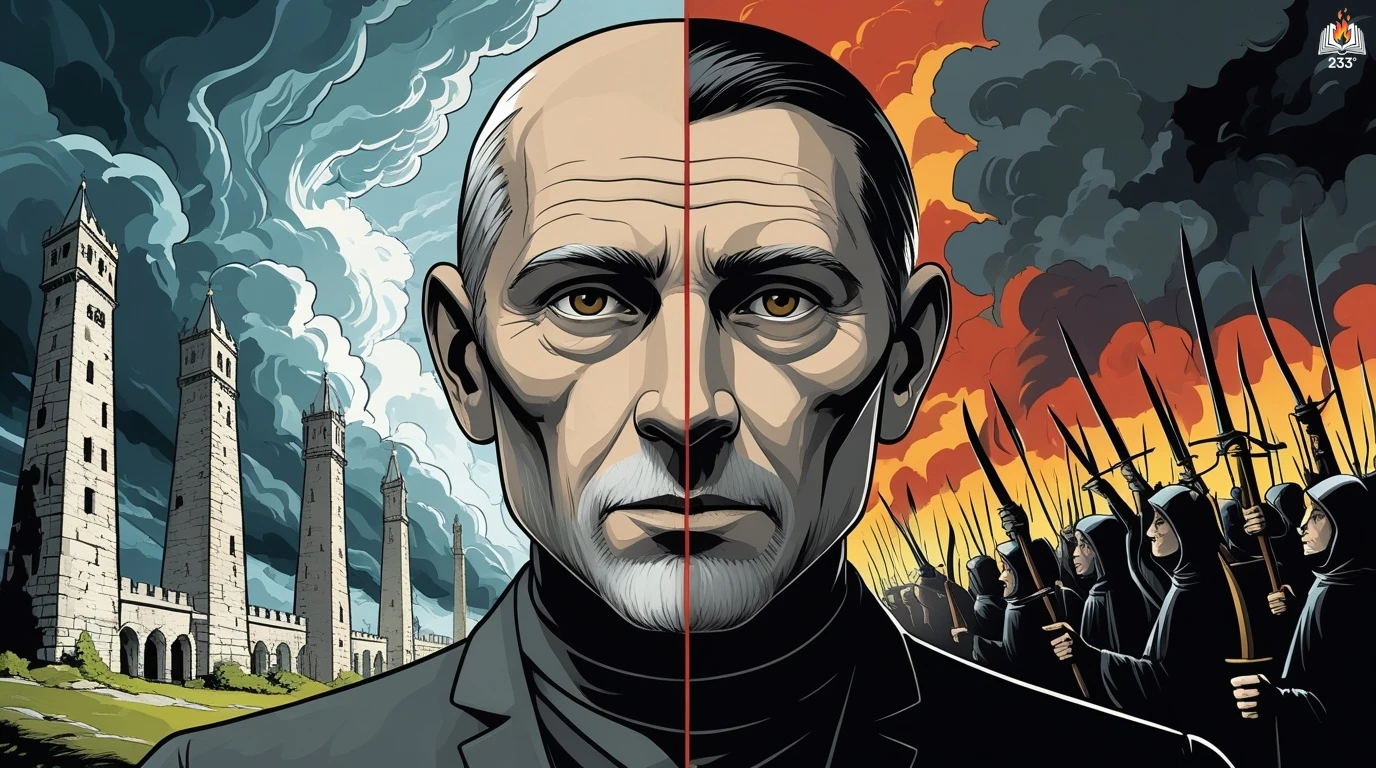
“Mitosis” by Brandon Sanderson, published in 2013, is a fast-paced novella set in the world of The Reckoners series, falling chronologically between Steelheart and Firefight. Set in the steel-coated metropolis of Newcago, the story picks up after the fall of the tyrannical Epic Steelheart, with David Charleston and the Reckoners now acting as protectors of the fledgling city. Their fragile new peace is challenged when a deadly Epic named Mitosis arrives, determined to prove that Steelheart’s death was a myth and that ordinary humans stand no chance against Epic power.
Plot Summary
In the steel-entombed streets of Newcago, sunlight finally touches the city after years of darkness. Steelheart, the tyrant who once ruled with an iron fist, is dead. The Reckoners, a resistance group that once operated in the shadows, now stand as defenders of a recovering metropolis. David Charleston, now known to many as Steelslayer, is trying to find his footing in this new world. Once fueled by vengeance, he is now a reluctant symbol of hope. But peace is a brittle thing, and Newcago’s wounds are fresh. The people still watch the sky, waiting for the return of their oppressors. And in the shadow of their unease, something begins to stir.
It begins innocently enough. A hot dog stand, laughter with Abraham, a day that almost feels normal. David is still haunted by memories of Megan, the girl who died and came back different, or maybe never truly left at all. While welcoming new immigrants at the city gate, a stranger catches his eye – jeans, tattoos, a presence that feels wrong. David follows him through the streets, and in a moment of uncanny horror, watches him split into two perfect copies. Then more. A dozen. A hundred. Mitosis has arrived.
Mitosis, once a guitarist named Lawrence Robert, now walks as a living army. Each of his clones is a version of himself, and each is as deadly as the last. He’s come with a singular purpose – to find and kill Steelslayer. He shouts his challenge into the wind, promising to execute a citizen every five minutes until David reveals himself. His clones, scattered across the city, repeat the same words like a chorus of death. Panic ripples through Newcago. The people, once trembling with the possibility of freedom, now face another Epic bent on domination.
David doesn’t run. He puts a bullet through one of Mitosis’s clones and draws their attention away from innocent lives. Tia, the Reckoners’ logistical mind, scrambles through old files for any weakness. Mitosis, she finds, has a flaw – a hatred for music, particularly his own. Once the proud creator of forgettable rock riffs, Mitosis now despises what he once was. But a weakness means nothing if it cannot be weaponized. David’s job is simple and terrifying: buy time. Distract the clones. Survive.
They swarm. David ducks through alleys and towers, over bridges of frozen rivers and through hotels once reserved for Steelheart’s elite. The clones multiply like a virus, each new copy bringing them closer. But their strength has limits. The more they divide, the more fragile they become. Their watches disintegrate, their clothing shreds, their weapons crumble to dust. Mitosis is tearing himself apart in his own fury.
Inside a steel hotel, David is cornered. Hands claw at his throat. Dozens of Mitosis clones pile into the room, each seeking to be the one who ends the myth of Steelslayer. In his last desperate move, David activates his mobile speaker. A song from Mitosis’s old band – Weaponized Cupcake – bursts into the air. The effect is immediate. The clone on top of him begins to melt, dissolving into goo, his bones evaporating into nothing. The others reel back in horror, a reflexive disgust triggered by the very sound that once defined them.
But the music fades. David’s strength is draining. He’s shot, blood running down his side. The clones renew their attack. He fights his way through windows, tunnels, and vents, each escape more frantic than the last. He sings, barely able to breathe, using the lyrics as a weapon. One clone after another melts in front of him. Still they come. One wields a knife, another a gun. They tighten their trap, crawling into the tunnel where David has hidden himself. He belts out another verse, hoarse and broken, but it is enough to destroy them. Until it isn’t.
Mitosis has found a way to stabilize his forms. As his numbers thin, their structure strengthens. A knife pierces David’s side. Blood pools in the tunnel. The clones demand the truth – how Steelheart really died, what Epic was responsible. David whispers the truth they don’t want to hear. Steelheart fell by his own hand, a trick of his own weakness, orchestrated by a common man. Mitosis calls it a lie. He wants a god to have fallen to a god. But David refuses to let him rewrite the past.
The tunnel grows darker. David’s voice fades. His fingers slip. Then, in the distance, a sound rises – not one voice, but many. Thousands. The people of Newcago, connected through the emergency message system, converge on the city center. Each carries a mobile. Each sings the same song. Off-key, imperfect, human. The clones begin to tremble. The connection between them – mental, emotional, unknowable – carries the song like a disease through their minds. Mitosis screams in fury, but the tide cannot be stopped. His army collapses in on itself. Clones burst, vanish, melt. Light pierces the tunnel, and David sees the people standing on the steel river, singing together.
He is pulled from the tunnel, barely conscious, bleeding and broken. Abraham carries him to safety. Prof returns, using his Epic-gifted abilities to heal the wounds. David lives. But something has changed. He is no longer just Steelslayer. He is a reminder – that courage can be louder than fear, that a city can stand even after it falls, and that common people, when they choose to rise, can bring down gods.
Newcago stands stronger than before. The Reckoners are not just rebels now – they are guardians. And David, still impulsive, still uncertain, still searching for Megan, knows one truth above all. This fight is far from over. But it is no longer his alone.
Main Characters
David Charleston (Steelslayer) – The protagonist and narrator, David is a clever, impulsive, and passionate young man driven by a deep-seated hatred for Epics, whom he blames for his father’s death. His journey from revenge-driven boy to tactical hero continues in Mitosis, where he steps into the spotlight as a symbol of rebellion and defiance against superhuman tyranny. Despite lacking powers himself, his courage and ingenuity mark him as a force to be reckoned with.
Mitosis (Lawrence Robert) – A new Epic threat, Mitosis is a chilling antagonist with the ability to clone himself endlessly. Once a musician, his loathing of his own music becomes a psychological Achilles’ heel. His terrifying multiplicity makes him a seemingly unstoppable foe, and his obsession with killing Steelslayer reveals his fear that a human could defeat an Epic.
Tia – The Reckoners’ intelligence specialist, Tia operates behind the scenes with brilliant analytical skills and technical savvy. Calm, sarcastic, and reliable, she acts as the team’s brain, deciphering weaknesses and coordinating the fight against Epics from her control center.
Abraham – A composed and philosophical member of the Reckoners, Abraham balances tactical precision with spiritual depth. Loyal and dryly humorous, his measured presence contrasts David’s impulsiveness. His faith in Newcago’s potential and David’s ideals adds emotional weight to the story.
Prof (Jonathan Phaedrus) – Though absent for most of the novella, Prof’s influence looms large. A secret Epic himself, he grants technology-based powers to the Reckoners, serving as a mentor and moral anchor, yet teetering on the edge of becoming what they fight against.
Theme
The Burden of Leadership and Heroism – David struggles with the weight of being a symbol. He is hailed as a hero, yet his self-image clashes with the ideal others project onto him. This tension fuels his growth as he learns that heroism isn’t about power, but about action and sacrifice.
Fear vs. Empowerment – The citizens of Newcago grapple with the lingering trauma of Epic tyranny. Their reluctance to embrace freedom reflects a broader theme: how fear can outlive oppression. Yet, the climax of the novella showcases a pivotal shift as ordinary people reclaim agency by standing up to Mitosis, demonstrating the power of collective resistance.
Identity and Self-Loathing – Mitosis embodies a disturbing paradox: he is both many and none. His ability to divide himself endlessly results in fragmentation, not strength. His hatred for his past and his music manifests as his vulnerability, exposing a deeper theme of self-loathing and the destruction it invites.
Technology and Surveillance – The novella reflects a world tightly interwoven with technology. From surveillance systems to mobile devices turned into weapons, Sanderson explores both the dangers and utilities of tech in a dystopian landscape, adding layers to the Reckoners’ tactical world.
Writing Style and Tone
Brandon Sanderson’s prose in Mitosis is sharp, vivid, and laced with signature wit. Written in first-person from David’s point of view, the narrative is energetic and colloquial, capturing both the intensity of life in post-Calamity America and the youthful, often humorous, perspective of its narrator. David’s inner monologue mixes action-hero grit with nerdy metaphors and awkward charm, giving the novella a distinctive voice that maintains levity even amid mortal danger.
Sanderson skillfully maintains a fast-paced rhythm, propelling the story forward with high-stakes action and suspense. Yet he also embeds philosophical inquiries into identity, courage, and the nature of power without breaking stride. His ability to inject depth without sacrificing momentum makes the tone both thrilling and thought-provoking. The fusion of superhero tropes with dystopian grit creates a world that is both familiar and strikingly original, inviting readers to question what makes a hero and what truly breaks a villain.
Quotes
Mitosis – Brandon Sanderson (2013) Quotes
“The day had finally arrived, a day I’d been awaiting for ten years. A glorious day, a momentous day, a day of import and distinction. It was time to buy a hot dog.”
“Some of us fought back with guns and assassinations. Others fought back with a little hot dog stand on the corner.”
“It’s okay. I’m a rhinoceros astronaut.” She was silent a moment. “Oh, sparks. You’re going delusional.” “No, no. I mean, I’m surprising. I’ll surprise him. What’s the most surprising thing you can think of? Bet it’s a rhinoceros astronaut.”
“A true Chicago dog looks like someone fired a bazooka at a vegetable stand, then scraped the remnants off the wall and slathered it on a tube of meat.”
“It’s okay. I’m a rhinoceros astronaut.”
“Epics have this habit of treating physics like something that happens to other people, like acne and debt.”
“You’re unreasonably lucky, son,” Prof said, settling onto the stool beside my hospital bed.”
“Air is really, really awesome.”
“Yeah,” I said. “Or glitter in soup.”
“A true Chicago dog looks like someone fired a bazooka at a vegetable stand, then scraped”
“Why would there be glitter in my soup in the first place?”
“I watched with disturbed fascination as the corpses decomposed, flesh turning to a pale tan goo. The bones melted after, and then the clothing. In seconds, each corpse was just a pile of colored gunk, and even that seemed to be evaporating.”
“I wanna kiss you!” I shouted. “Like the wind kisses the ra-i-ain!”
“It's okay. I'm a rhinoceros astronaut.”
“Air. Air is really, really awesome.”
We hope this summary has sparked your interest and would appreciate you following Celsius 233 on social media:
There’s a treasure trove of other fascinating book summaries waiting for you. Check out our collection of stories that inspire, thrill, and provoke thought, just like this one by checking out the Book Shelf or the Library
Remember, while our summaries capture the essence, they can never replace the full experience of reading the book. If this summary intrigued you, consider diving into the complete story – buy the book and immerse yourself in the author’s original work.
If you want to request a book summary, click here.
When Saurabh is not working/watching football/reading books/traveling, you can reach him via Twitter/X, LinkedIn, or Threads
Restart reading!