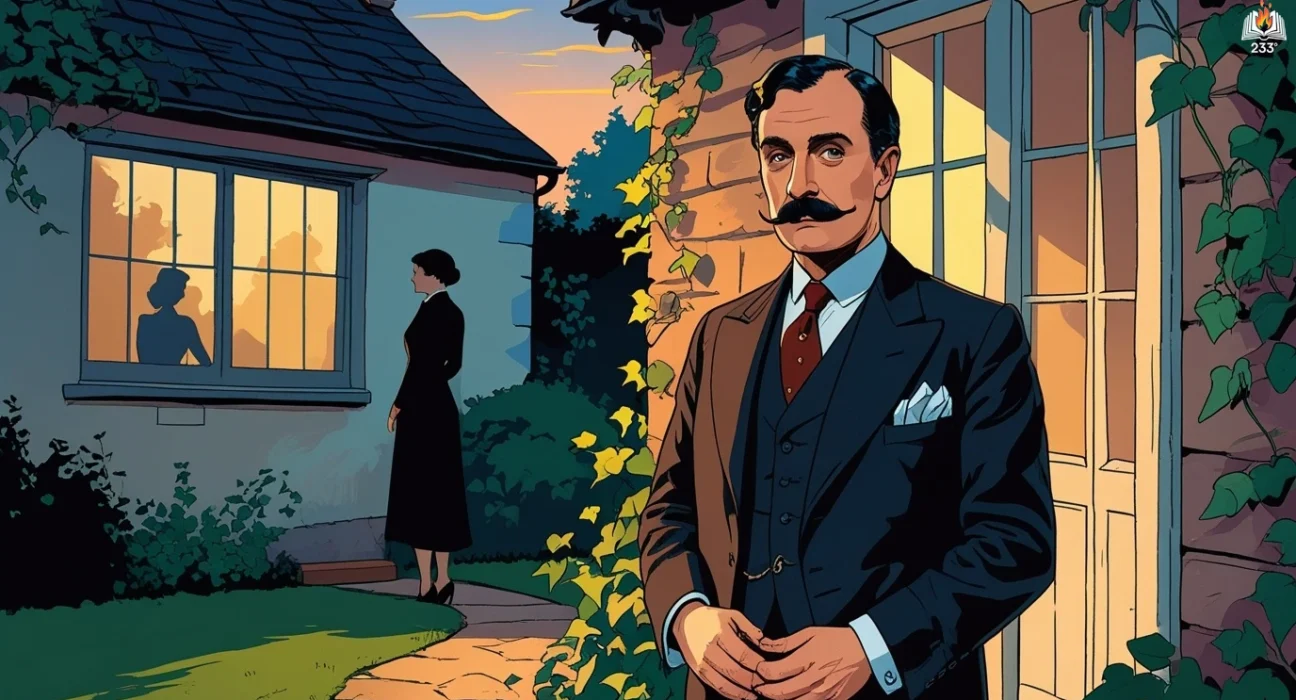
After the Funeral by Agatha Christie, published in 1953, is part of the beloved Hercule Poirot series. Set in the aftermath of the wealthy Richard Abernethie’s funeral, the novel spins a web of family secrets, suspicions, and murder when Richard’s sister, Cora Lansquenet, is brutally killed shortly after remarking that her brother’s death was not natural. Hercule Poirot is called in to untangle the mystery, uncovering hidden motives and long-buried resentments among the Abernethie family.
Plot Summary
When Richard Abernethie, the wealthy patriarch of the Abernethie family, was laid to rest, his relatives gathered dutifully for the funeral. The solemnity of the occasion was briefly shattered when his sister, Cora Lansquenet, with her blunt and childlike candor, remarked that Richard had been murdered. Those present were startled, uneasy, but most dismissed her as a silly, tactless woman prone to saying outrageous things. Yet, the day after the funeral, Cora herself was found dead, struck down brutally with a hatchet in her cottage, silencing her forever.
Mr. Entwhistle, the Abernethie family solicitor, had long been familiar with the family’s tangled relations. He had watched them at the funeral – George, the outwardly affable but desperate nephew; Rosamund, dazzling yet shallow, alongside her charming but struggling husband, Michael; Susan, the keen and determined niece with an adoring yet overshadowed husband, Gregory; and Timothy, the frail, querulous brother who rarely left his Yorkshire home, fussed over by his formidable wife, Maude. With Cora’s death casting a sinister shadow over the family, Entwhistle felt unease stir in his normally precise mind. If Richard’s death had been unnatural, and Cora had been silenced for speaking the truth, then there was a murderer among them.
Entwhistle’s instincts led him to summon the brilliant Belgian detective, Hercule Poirot. Though Poirot appeared calm and detached, behind his thoughtful gaze the little grey cells worked tirelessly. He saw not a family mourning a sister’s death, but a collection of suspects, each with grievances, ambitions, and secrets.
Cora, it seemed, had lived modestly, her companion Miss Gilchrist at her side, dreaming of art, escape, and a second chance at life. Miss Gilchrist spoke of Cora’s optimism after the funeral, her plans to visit Capri, her excitement at the modest inheritance Richard had left her. Yet just as her dreams bloomed, they were savagely cut short. The crime scene, the smashed window, the discarded trinkets, all spoke of a bungled burglary – or so it was meant to appear.
Poirot and Entwhistle moved among the family, peeling back layers of civility to reveal jagged edges. George, his finances crumbling, had been barely holding back ruin. Rosamund, enraptured by her actor husband’s schemes, needed capital for his next big chance. Susan, cool-headed and pragmatic, had plans of her own, determined to break free from her narrow life with Gregory. And Timothy, far from being a dying invalid, was comfortably ensconced in his own web of imagined ailments, guarded fiercely by Maude.
As Poirot dug deeper, the household dynamics came alive. Maude recounted the telephone that failed just when Entwhistle tried to reach them, a curious coincidence. Miss Gilchrist, in her modesty, revealed a longing for the past, especially for her lost tea shop, a dream crushed by wartime shortages. Gregory’s quiet presence seemed more uneasy as questions mounted. Meanwhile, Rosamund and Michael danced between frivolity and calculated ambition, while George made polished excuses for his increasingly transparent desperation.
Poirot noted the contradictions. Richard Abernethie had been robust, in control of his faculties, and his death by natural causes, though accepted, now carried the whiff of something darker. Cora’s careless remark, laughed off by all, may have been the inconvenient truth that cost her life. And yet, why should anyone kill Cora over a remark if Richard’s death was perfectly ordinary?
The will, of course, was key. Richard had divided his estate generously among his family, but the share left to Cora, with her death, was redistributed to the others. Poirot saw in this the quiet hand of motive, greed wrapped in affection, ambition cloaked in grief.
The old lawyer moved from London to the countryside, visiting Timothy and Maude in their neglected estate, seeing firsthand the decay masked by their proud insistence. He watched Susan’s energetic drive as she planned to launch a business, her husband lurking in her shadow. He sat in the shabby, art-stuffed cottage where Cora had once lived, listening as Miss Gilchrist reminisced about better days and simpler joys. With each encounter, Poirot sifted through words, gestures, and memories, collecting not just facts, but the essence of each player in this quiet tragedy.
The turning point came with something small and easily overlooked – a painting. Cora’s passion for collecting art, most of it worthless, had led her to a modest discovery. One painting, an Italian Primitive, turned out to be remarkably valuable, a hidden gem among the clutter. To Cora, it was perhaps no more than a treasure she had stumbled upon at a local sale. To someone else, it was a fortune worth killing for.
The pieces fell together with chilling clarity. Miss Gilchrist, the quiet companion, had endured years of genteel poverty, her beloved tea shop lost in the war, her independence sacrificed. Cora’s death, staged as a burglary gone wrong, had been a desperate grasp at reclaiming that lost life. Yet the painting had not been enough. When Cora’s will left Miss Gilchrist only a brooch and a few sentimental sketches, despair had tipped into violence.
Poirot, with his unfailing sense of human frailty, laid out the truth gently but firmly. Miss Gilchrist had first killed Cora, then woven the scene of a bungled robbery. She had been clever, almost too clever, discarding the stolen jewels in a nearby bush, mimicking the clumsiness of an opportunistic thief. She had even impersonated Cora in a crucial phone call to make it seem that Cora was alive after the attack. But the façade crumbled when Poirot revealed the damning evidence – a carefully swapped painting, the real masterpiece hidden away, the rest of the stage set to fool the police.
The revelation shocked the Abernethie family, peeling away their petty schemes and exposing the human heart of the crime – not vast greed or cold ambition, but the quiet desperation of a woman who had once poured tea beneath blue willow china, dreaming of her little shop, and who, in a moment of madness, saw murder as her only escape.
In the quiet that followed Poirot’s explanation, the family was left to reckon with the ripples of tragedy. Richard’s wealth, once the object of their restless hopes, now seemed tarnished, the cost laid bare. The Abernethie name, the great fortune, the gathering of heirs – all had been little more than a backdrop to a crime of loneliness and longing.
Poirot departed with his usual elegance, leaving behind a family forever altered. The curtain fell not with dramatic pronouncement but with a quiet settling of truths, as the Abernethies turned back to their lives, each shadowed now by the knowledge of how thin the line is between the appearance of respectability and the reality of human weakness.
Main Characters
Hercule Poirot: The meticulous Belgian detective, known for his razor-sharp intellect and keen psychological insights. Poirot approaches the Abernethie case with his signature blend of patience and method, sifting through lies and facades to expose the killer.
Mr. Entwhistle: The family solicitor and a longtime friend of Richard Abernethie, Entwhistle becomes suspicious after Cora’s murder and initiates the investigation. His concern for justice propels the narrative and leads him to call in Poirot.
Cora Lansquenet: Richard’s eccentric and tactless sister, whose startling claim at the funeral—“He was murdered, wasn’t he?”—places her in the killer’s crosshairs. Her brutal death becomes the catalyst for unraveling the mystery.
Richard Abernethie: The recently deceased family patriarch whose sudden death sparks suspicion. Though absent in life, his influence looms over the characters, and his past decisions shape their present motives.
Miss Gilchrist: Cora’s genteel but financially struggling companion, who appears timid and sensible but harbors her own aspirations and frustrations. Her observations provide important clues, and she becomes central to the investigation.
Timothy Abernethie: Richard’s hypochondriac brother, confined at home and obsessed with his health, whose self-centeredness masks deeper layers of anxiety and fear.
Susan Banks: Richard’s ambitious and determined niece, a sharp-witted businesswoman. She is fiercely devoted to her husband but is also calculating and practical, driven by a desire for independence and success.
George Crossfield: The charming yet financially desperate nephew, whose charm hides an unscrupulous streak. His need for money makes him an obvious suspect.
Rosamund Shane and Michael Shane: Rosamund is Richard’s beautiful, somewhat shallow niece, married to Michael, a struggling actor. Their glamorous but precarious lifestyle puts them under suspicion as potential beneficiaries of Richard’s wealth.
Theme
Greed and Inheritance: Central to the novel is the question of money and inheritance. Richard’s fortune casts a shadow over his relatives, exposing their desires, resentments, and willingness to manipulate or deceive to secure wealth.
Family Secrets and Resentments: Christie explores the dysfunction lurking beneath polite family facades. Long-standing grievances, jealousy, and bitterness bubble to the surface in the wake of Richard’s death, driving suspicion and conflict.
Truth and Deception: The novel is steeped in misdirection, with characters presenting false fronts or concealing vital information. Poirot’s genius lies in cutting through these layers to uncover the truth.
The Power of Observation: Small details, overheard remarks, and seemingly trivial actions become crucial in solving the mystery. Christie highlights how sharp observation can reveal hidden motives and untangle complex human behavior.
Writing Style and Tone
Agatha Christie’s writing in After the Funeral is masterfully crisp and economical, weaving a labyrinthine plot with effortless precision. She excels at dialogue that reveals character and motive, using seemingly mundane conversations to plant subtle clues. Christie’s narrative voice maintains a cool detachment, inviting readers to become armchair detectives alongside Poirot.
The tone of the novel balances wit, irony, and menace. Christie is particularly adept at mixing domestic humor—particularly in scenes with the hypochondriac Timothy or the artistic but hapless Michael Shane—with an underlying tension that keeps readers on edge. The psychological insights she embeds in character interactions add depth, making the novel as much a study of human nature as a cleverly constructed puzzle.
Quotes
After the Funeral – Agatha Christie (1953) Quotes
“For in the long run, either through a lie, or through truth, people were bound to give themselves away ...”
“Yes, yes-you will give him the earth-because you love him. Love him too much for safety or for happiness. But you cannot give to people what they are incapable of receiving.”
“It is a profound belief of mine that if you can induce a person to talk to you for long enough, on any subject whatever! sooner or later they will give themselves away.”
“To see ourselves as others see us!”
“The very simple-minded have often the genius to commit an uncomplicated crime and then leave it alone.”
“But if I am right,” thought Poirot, “and after all, it is natural to me to be right”
“I am in my own line a celebrated person—I may say a most celebrated person. My gifts, in fact, are unequalled!”
“the world is full of the young – or even the middle-aged – who wait, patiently or impatiently, for the death of someone whose decease will give them if not affluence – then opportunity”
“Women are never kind,’ remarked Poirot. ‘Though they can sometimes be tender.”
“Funerals are absolutely fatal for a man of your age.”
“It would underline the point that it is unwise to make jokes about murder," said Poirot drily.”
“It shows you, Madame, the dangers of conversations. It is a profound belief of mine that if you can induce a person to talk to you for long enough, on any subject whatever! sooner or later they will give themselves away.”
“Sometimes, is it not, the Past will not be left, will not suffer itself to pass into oblivion? It stands at one’s elbow—it says, ‘I am not done with yet.”
“Let us admit without more ado that the world is full of the young—or even the middle-aged—who wait, patiently or impatiently, for the death of someone whose decease will give them if not affluence—then opportunity.”
“The old shouldn’t stand in the way of the young.”
“The value of money is always relative,” said Mr. Entwhistle. “It is the need that counts.”
“there is no”
“Women are never kind,’ remarked Poirot. ‘Though they can sometimes be tender”
“But you cannot give to people what they are incapable of receiving.”
“Everyone had accepted U.N.A.R.C.O. as a matter of course—had even pretended to know all about it! How averse human beings were ever to admit ignorance!”
“little drop cakes.”
“The woman’s at a certain time of life—craving for sensation, unbalanced, unreliable—might say anything. They do, you know!”
“Women are never kind,” remarked Poirot. “Though they can sometimes be tender.”
“Wives madly devoted to unsatisfactory and often what appeared quite unprepossessing husbands, wives contemptuous of, and bored by, apparently attractive and impeccable husbands.”
“At my age, the main pleasure, almost the only pleasure that still remains, is the pleasure of the table,”
We hope this summary has sparked your interest and would appreciate you following Celsius 233 on social media:
There’s a treasure trove of other fascinating book summaries waiting for you. Check out our collection of stories that inspire, thrill, and provoke thought, just like this one by checking out the Book Shelf or the Library
Remember, while our summaries capture the essence, they can never replace the full experience of reading the book. If this summary intrigued you, consider diving into the complete story – buy the book and immerse yourself in the author’s original work.
If you want to request a book summary, click here.
When Saurabh is not working/watching football/reading books/traveling, you can reach him via Twitter/X, LinkedIn, or Threads
Restart reading!