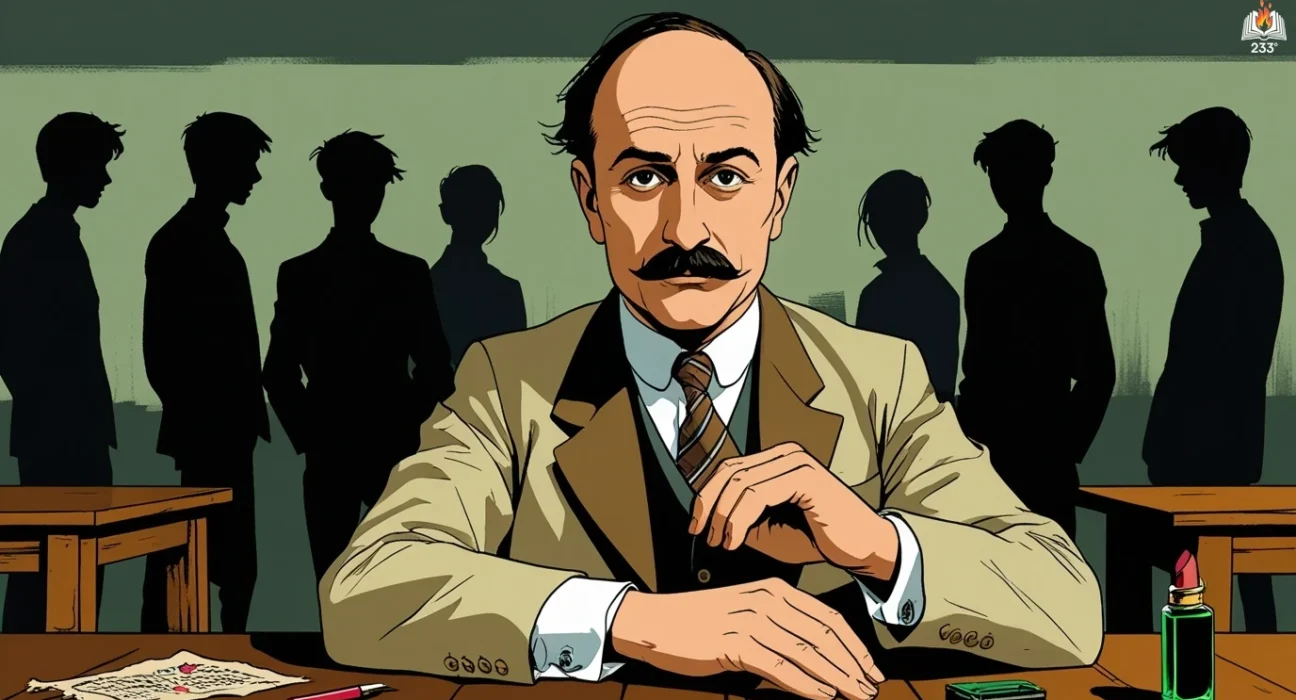
Hickory Dickory Death by Agatha Christie, published in 1955, is one of the celebrated Hercule Poirot mysteries, part of the famous series featuring the meticulous Belgian detective. Set in a London student hostel, the novel unfolds after a series of petty thefts escalates into murder, drawing Poirot into a tangled web of secrets, jealousy, and deception.
Plot Summary
At 26 Hickory Road, a London student hostel brimming with young scholars from around the world, the rhythms of everyday life are disrupted in the most peculiar way. Odd thefts plague the household – a missing shoe, a rucksack slashed to pieces, a diamond ring plopped into a plate of soup, a lipstick gone astray, green ink splattered over important notes. Mrs. Hubbard, the hostel’s competent matron, is perplexed. She seeks help from her sister, Miss Lemon, the famously precise secretary of Hercule Poirot. And Poirot, intrigued by the chaos disrupting his normally impeccable Miss Lemon, agrees to investigate.
When Poirot arrives at the hostel, he finds a lively, tangled web of personalities. There’s Nigel Chapman, sharp-tongued and provocative, eager to stir up arguments; Patricia Lane, thoughtful and earnest, pursuing archaeology; Len Bateson, the fiery medical student; Sally Finch, a bright American on scholarship; Valerie Hobhouse, chic and self-assured, working at a beauty shop; Jean Tomlinson, a kind physiotherapist; Mr. Akibombo, the polite and observant West African student; Colin McNabb, the psychiatrist-in-training with an academic coolness; and Celia Austin, the timid, gentle dispenser at a local hospital. Poirot senses the undercurrents beneath the hostel’s surface – affection, jealousy, rivalries, and simmering tensions.
The thefts escalate. Elizabeth Johnston, a diligent law student from the West Indies, finds her hard-earned study notes destroyed by a smear of green ink. Valerie’s silk scarf is slashed, Len’s cherished old trousers disappear, and Sally’s missing shoe mysteriously turns up at Baker Street Station, just as Poirot predicts. The atmosphere turns uneasy, laughter thinning into guarded glances.
Poirot gathers the household together, giving what seems to be an innocuous lecture on his past cases. But his sharp eyes are at work, studying the students as they listen, watching their reactions, feeling the quivers of anxiety ripple through the room. Afterward, Colin McNabb confronts Poirot, confident in his own psychological interpretations, convinced that the disturbances spring from a troubled, craving soul, not a criminal mind. Poirot, however, knows better than to be swayed by academic certainty.
Celia Austin breaks under the weight of her guilt. Tearfully, she confesses to stealing several items – the shoe, the powder compact, the lipstick, the jewelry. She wanted attention, she claims, but the ink spill, the cut-up scarf, the rucksack – those were not her doing. Colin steps in, protective and earnest, promising to help Celia heal, and the hostel breathes a sigh of relief. The thief, it seems, has been unmasked, and life can return to normal.
But normal never truly returns to Hickory Road.
Within days, Celia is found dead in her room, a bottle of morphine capsules by her side. The residents are stunned. Was it shame that drove her to end her life? Poirot, unshaken and methodical, thinks not. He peers deeper, his mind working through the lattice of lies and half-truths. The police find no suicide note, and Poirot detects something chilling in the details. Celia had been taking steps toward recovery, even buying replacements for the stolen items. The possibility of murder now casts its dark shadow over the hostel.
Poirot turns his attention to the ring of relationships surrounding Celia. There is Colin, the would-be protector, whose psychology lectures mask an authoritarian streak. There’s Nigel, with his sarcastic charm and a past tangled with fraud. Valerie, elegant and ambitious, seems unshaken by the death, while Sally, the cheerful American, is seen slipping away on sudden trips. Beneath the surface hum of communal living, Poirot senses the electric buzz of fear, resentment, and hidden motives.
His questions lead him to unravel the connections behind the thefts. He discovers that Sally Finch is not merely a Fulbright scholar but also an undercover agent investigating the smuggling of stolen drugs and jewels across borders. The missing morphine from Len’s medical supplies now takes on sinister meaning. Len, furious over the theft, had no idea that the hostel was a staging ground for a smuggling operation.
Meanwhile, Poirot’s focus sharpens on Nigel. Beneath his clever exterior lies a man with a secret – forged academic records, a shadowy past, and a need to control those around him. Nigel’s relationship with Patricia carries an unsettling tension, while his manipulations ripple through the lives of the other students. Yet even Nigel’s scheming nature does not account for the final brutal act.
Another murder strikes – Mrs. Nicoletis, the volatile and greedy hostel owner, is found strangled, her body left sprawled in her overheated sitting room. The household shudders with shock. With two deaths and a trail of thefts, Poirot knows the time has come to gather the remaining players and bring the truth into the light.
In a gathering thick with suspense, Poirot lays bare the tangled skein of guilt. Celia, vulnerable and eager to belong, had been manipulated into the thefts, but her death was not of her own hand. Nigel, desperate to cover his tracks, administered the morphine and staged her death as a suicide. His forgeries had come to light, and Celia, sweet-natured and unaware of the full depth of his deceit, became a threat he could no longer manage.
Mrs. Nicoletis, who had been blackmailing Nigel after discovering his criminal past, was silenced before she could expose him. The petty thefts had never been mere childish pranks or cries for help – they were chess moves in a dangerous game of concealment and control.
As the truth unravels, the remaining residents face the shattering realization of the betrayals among them. Patricia, loyal and gentle, is left to reckon with Nigel’s true nature. Len, once quick-tempered and loud, finds his boisterousness dulled by grief. Valerie, calculating and smooth, retreats behind her cool façade. Sally, relieved to complete her investigation, departs with a blend of triumph and sorrow. And Poirot, with his customary grace, steps away from Hickory Road, leaving the students to rebuild their lives in the uneasy quiet after the storm.
Main Characters
Hercule Poirot: The brilliant and fastidious Belgian detective, Poirot applies his “little grey cells” to unravel the mystery. His methodical approach and deep understanding of human psychology are central as he peels back the layers of deceit within the hostel.
Miss Lemon: Poirot’s usually flawless secretary, Miss Lemon is distracted in this novel due to concern over her sister. Her unusual mistakes trigger Poirot’s involvement in the case, adding a rare personal angle to her normally mechanical precision.
Mrs. Hubbard: The concerned and kind-hearted manager of the hostel, Mrs. Hubbard seeks Poirot’s help after noticing troubling events. Her maternal nature and affection for the students make her both a source of information and a symbol of emotional investment.
Nigel Chapman: A mischievous, slightly malicious student with a sharp tongue and a complex past, Nigel’s personal history and volatile temperament make him both a suspect and a tragic figure in the unfolding drama.
Patricia Lane: A maternal and earnest student of archaeology, Patricia’s protective instincts and quiet strength stand out, though her naiveté also places her in danger.
Len Bateson: The big, fiery red-haired medical student, Len is boisterous yet kindhearted, but his temperament and medical knowledge raise suspicions when murder strikes.
Sally Finch: An American student, Sally is vivacious and sharp, able to play roles and charm those around her. Her wit and adaptability make her both a potential suspect and an ally.
Jean Tomlinson: A sweet-natured physiotherapy worker, Jean’s moral uprightness belies her potential as a suspect, reminding us that outward innocence can be deceptive.
Valerie Hobhouse: Stylish and intelligent, Valerie works in the beauty industry and has a sophisticated, sometimes calculating air, making her an enigmatic presence among the students.
Mr. Akibombo: A gentle, polite West African student, Akibombo offers unique cultural insights and often surprises others with his astute observations.
Theme
Deception and Identity: False appearances pervade the hostel, as nearly every character harbors a secret or hidden identity. This theme intensifies the mystery and underscores Poirot’s belief that to solve a crime, one must look beneath the surface.
Jealousy and Rivalry: Romantic entanglements, academic competition, and cultural clashes fuel tensions among the students. These rivalries create a simmering atmosphere that ultimately leads to betrayal and violence.
Cultural and Social Diversity: The hostel’s international mix of residents reflects postwar London’s changing landscape. Christie explores the misunderstandings, prejudices, and opportunities arising from this diversity, adding both humor and tension.
The Fragility of Order: From Miss Lemon’s mechanical perfection cracking under emotional strain to Poirot’s investigation revealing chaos behind a seemingly orderly residence, Christie probes the thin line between stability and disorder in human life.
Writing Style and Tone
Agatha Christie’s writing style in Hickory Dickory Death is concise and deceptively simple, laced with sharp dialogue and subtle character details. She excels at pacing, allowing the mystery to unfold in carefully timed revelations, and her prose balances light domestic humor with dark psychological insight. The clipped exchanges between Poirot and suspects are crafted with wit, keeping the narrative lively even amid grim events.
The tone shifts between playful and ominous, a signature Christie blend. The initial lightness, with petty thefts and comical misunderstandings, gradually darkens as suspicion, fear, and death creep into the hostel. This tonal contrast heightens the tension and mirrors Poirot’s method – moving from the trivial to the profound, from surface details to the truth beneath. Christie’s deft control of mood allows the novel to explore weighty themes without losing its charm or accessibility.
Quotes
Hickory Dickory Death – Agatha Christie (1955) Quotes
“What are you doing, Poirot?" "I dissect rucksacks. It is very interesting.”
“The parsley sinking into the butter on a hot day,”
“But it is beautiful, my friend,” said Hercule Poirot with admiration. “So clear—so beautifully clear.” “You sound as if you were talking about soup,” grumbled the inspector. “It may be Consommé to you—but to me there’s a good deal of thick Mock Turtle about it still.”
“Of course I could give you advice, Jean, though I don’t know why anyone ever wants advice. They never take it.”
“Is nobody incapable of murder?” “I have often wondered.” said Hercule Poirot.”
“How many psychologists does one know to whom it might be said: Physician, heal thyself?”
“I can’t say I’ve ever had time to read any of the stories. When I do get time for reading, which isn’t very often, I prefer an improving book.”
“All this began with a rucksack.”
We hope this summary has sparked your interest and would appreciate you following Celsius 233 on social media:
There’s a treasure trove of other fascinating book summaries waiting for you. Check out our collection of stories that inspire, thrill, and provoke thought, just like this one by checking out the Book Shelf or the Library
Remember, while our summaries capture the essence, they can never replace the full experience of reading the book. If this summary intrigued you, consider diving into the complete story – buy the book and immerse yourself in the author’s original work.
If you want to request a book summary, click here.
When Saurabh is not working/watching football/reading books/traveling, you can reach him via Twitter/X, LinkedIn, or Threads
Restart reading!