Rant: An Oral Biography of Buster Casey by Chuck Palahniuk, published in 2007, is a darkly experimental novel crafted in the form of an oral history. It constructs the life and myth of Buster “Rant” Casey through a mosaic of conflicting testimonies and interviews. Assembled by an unnamed editor, the story unfolds posthumously through those who knew Casey best – or thought they did – blending science fiction, horror, satire, and philosophical inquiry in a narrative that challenges linear storytelling and the very nature of truth.
Plot Summary
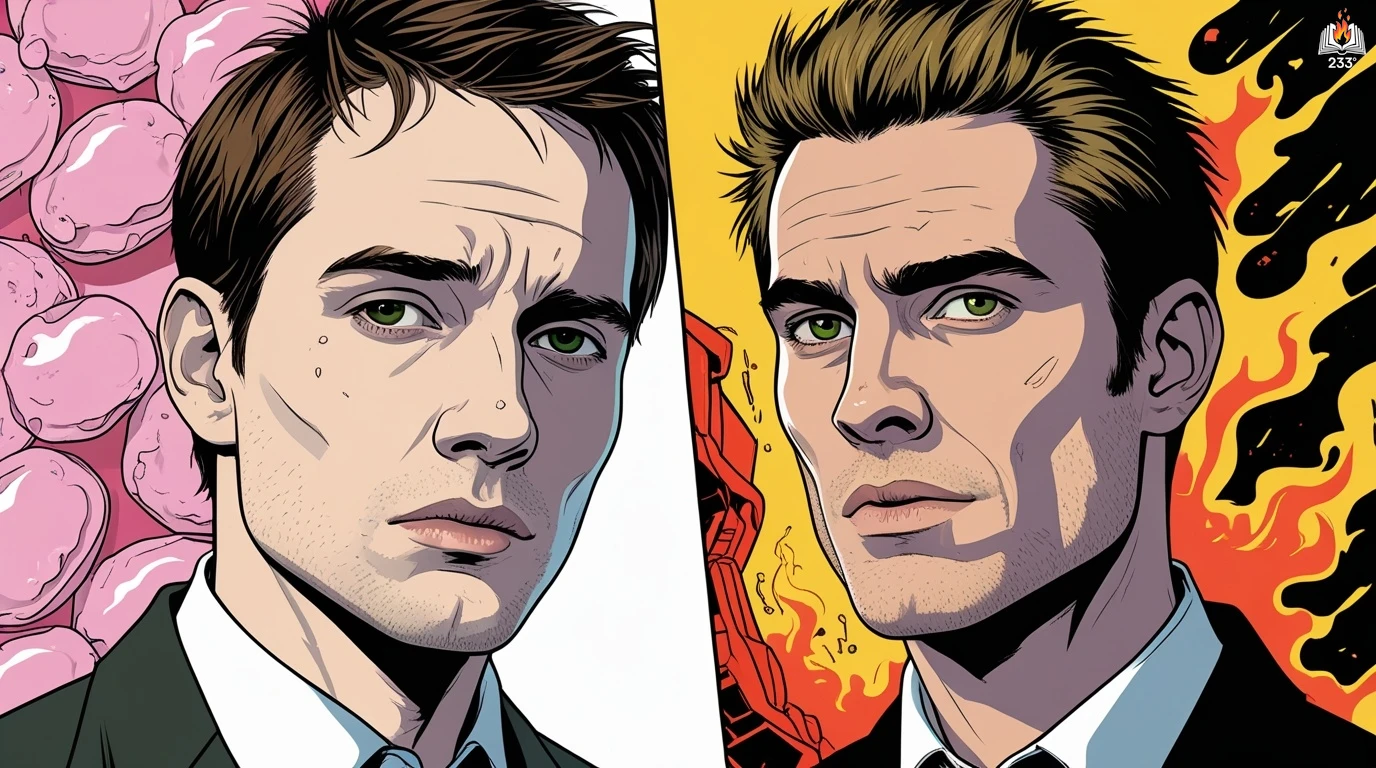
In the dust-swept outskirts of Middleton, a boy named Buster Landru Casey was born to a teenage mother and a quiet, withdrawn father. Before he earned names like Rant or Mad Dog, before his blood ignited a pandemic, before strangers remembered him as the superspreader or America’s Kissing Killer, he was just a child who picked his nose and pasted dried snot on the wall above his bed. His mother had named him Buddy. His father called him Buster. His childhood friend called him Rant. Everyone had their own name for him, the way people try to own a piece of what they love, or fear.
The house he grew up in smelled of boiled vinegar and garden soil. At Easter, his mother dyed eggs with melted wax and cabbage water, while his father looked at the efforts with disdain, cracking invisible art against the edge of the sink for a quick lunch. Rant’s egg – striped green and yellow, with lines drawn like longitude and latitude – wasn’t a pineapple, as his mother assumed. It was a hand grenade. The idea had already begun to hatch inside him, an understanding of destruction as artistry.
One Easter morning, while hunting for those same eggs hidden in tulip beds, Rant reached beneath a bush and was bitten on the hand by a black widow spider. His fingers swelled, his veins turned purple, and the pain became something familiar. Something comforting. Later, he would say that was the moment everything changed. That venom had taught him not to fear poison, but to chase it.
As a boy, Rant had a sense of smell so acute it bordered on supernatural. He could name people by the scent of their blood, tell secrets hidden in laundry and condoms flung over fences. In Middleton, with its rusted trailers and bone-dry fields, he grew up among kids who believed in werewolves and cursed fossils, in Sex Tornadoes and angels born with dirty fingernails. Even then, he was different. In school, he made girls cry by naming what time of the month they were on. He brought home roadkill and dismembered it with joy. He stuck his hand into animal dens to see what would bite back.
Rant’s grandmother, Esther, died from another black widow bite, or so it seemed. She collapsed on the way to church, her hat torn off, hair yanked out, a red dot soaking into a tissue. But when they reached her body later, the dogs had already found her. Her death left a vacuum, an empty chair at the adult table. Irene, Rant’s mother, moved up to take it, and the bitter reshuffling of roles became another lesson he never forgot – that death makes room.
In adolescence, Rant began infecting himself on purpose. Rabies, tetanus, anything with a burn or fever. He visited brothels and let diseased women bite his neck. He pressed his blood into others with mouth and hands. Not for cruelty. For communion. For transformation. Every bite passed something forward. It wasn’t long before entire towns shut down. The government quarantined cities. Fever scanners at airports blinked and wailed. People vanished behind fences and were never seen again.
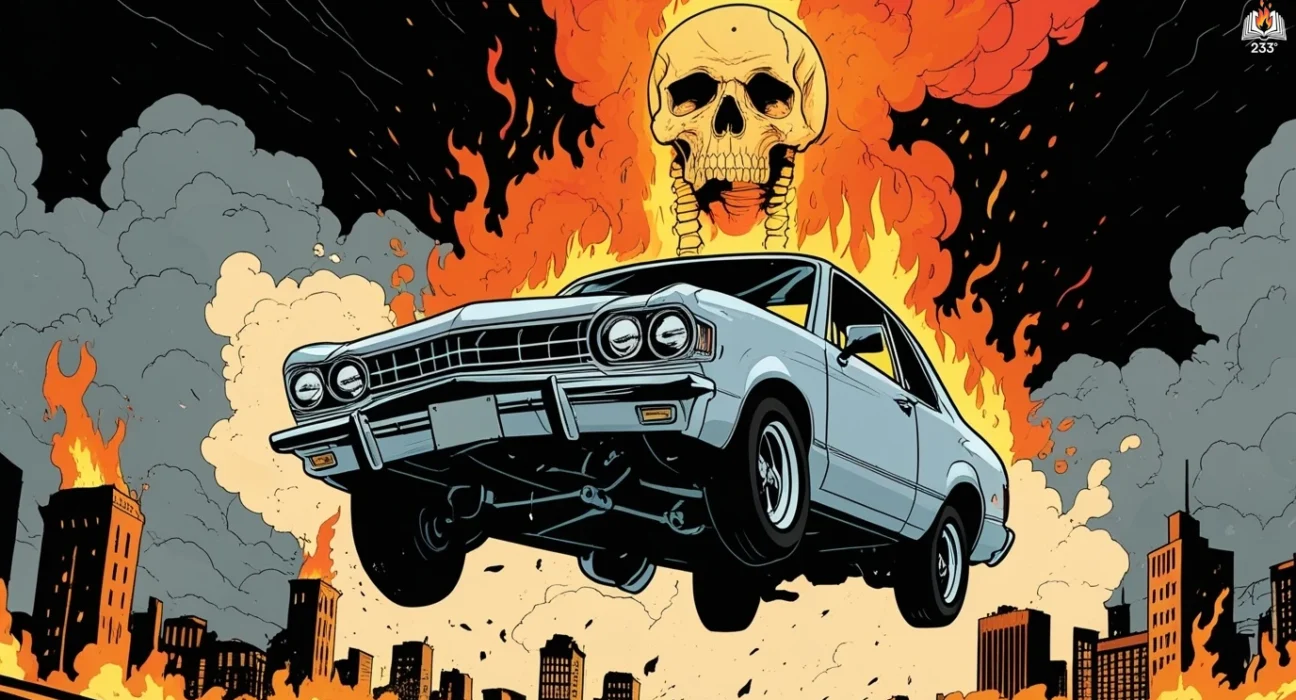
He fled to the city, where he found the Nighttimers – people who lived only after dark, rejected by the Daytimer class. Among them, he discovered Party Crashing, an illegal subculture of car crashes. People would soup up junkers and slam into each other at pre-arranged intersections. The thrill wasn’t just in the wrecks – it was in letting go of time, of identity, of the need for control. Rant crashed his car night after night, wearing new faces of bruises and blood. He earned a myth. Some said he was immortal, that he could die and return in another body. Others claimed he’d traveled through time, changing the past. All the while, his infection spread like gospel.
He met Echo Lawrence, a woman with scars like roadmaps and a rage that mirrored his. She was beautiful in a way that hurt to see. Their connection went deeper than romance, twisted like roots. She joined him in Party Crashing, in the blood rituals, in the undoing of linear life. With her and others – Shot Dunyun, Neddy Nelson, and a growing cast of believers – Rant built a network. Not just of Party Crashers, but of people willing to discard their programmed lives. He became a god for the infected.
Whispers of time travel emerged from the mouths of historians and madmen. Green Taylor Simms, a man too knowing for comfort, suggested that Rant wasn’t merely sick – he was the fulcrum of a new temporal order. That through recursive death and rebirth, Rant was changing the shape of history. That he wasn’t just spreading disease, but altering fate.
Rant’s final crash was supposed to be his end. A fireball that lit up the sky and cooked the metal into bone shapes. Eyewitnesses saw it. Newscasters confirmed it. But no body was ever recovered. His father, Chester Casey, flew across the country to claim the remains, buying a bereavement ticket for fifty dollars. A cheap price for the end of the world. And yet, the moment he told the story to a stranger on a plane, the stranger realized the man wasn’t mourning – he was building legend.
The people Rant touched kept his virus alive. Not the one in their blood, but the one in their minds. His name became a prayer, a slur, a code. His sayings – written on the walls of alleys, whispered in hospital beds, passed in wrecked cars – lingered like incense. Some people are just born human. The rest take a lifetime. Life’s greatest comfort is looking back and seeing someone worse off behind you.
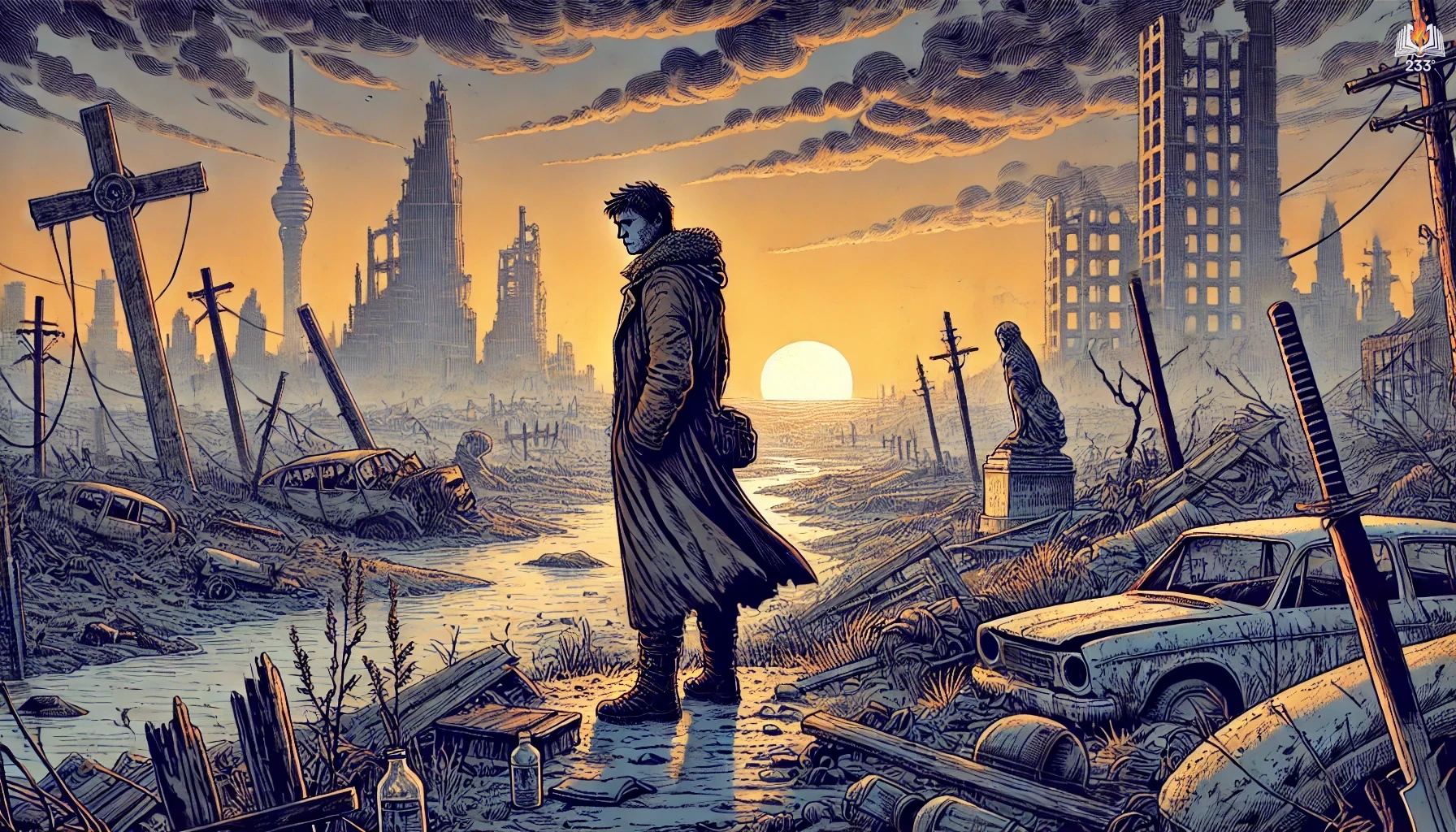
In Middleton, the wheat grew back. The dogs kept howling. Irene painted over the stars on the ceiling of her dead son’s room and pretended they were never there. Echo listened to static and traffic reports from other time zones, chasing Rant’s voice in the noise. Somewhere in the radio buzz of cities burning in future days, she thought she heard him.
It was never about truth. Truth was fragile, the kind of thing you could crack against a sink and eat in two bites. What survived was memory, smeared and stitched, collected like teeth in a wagon, passed from hand to hand. In the end, everyone became a witness. Not to who Rant Casey was – but to the hole he left in time.
Main Characters
Buster “Rant” Landru Casey: The enigmatic and disturbing central figure, whose life is pieced together through conflicting recollections. Rant evolves from a small-town oddity with a superhuman sense of smell and a fascination with disease and death into a viral legend who incites societal collapse. His actions blur the line between myth and reality, casting him alternately as a madman, a prophet, and a revolutionary.
Chester Casey: Rant’s father, whose views shift between pride and regret. Chester’s anecdotes offer early glimpses into Rant’s childhood and trauma, particularly the unsettling psychological distance between them and the damage inflicted by parental neglect.
Irene “Reen” Casey: Rant’s mother, a woman once full of artistic ambition, whose early motherhood and strict domestic expectations stifle her. Her transformation into a jaded, quietly broken figure marks one of the first emotional ruptures in Rant’s life.
Echo Lawrence: A Party Crasher and Rant’s complex love interest. With a damaged past and a penchant for pain, Echo is drawn to Rant’s chaos. Her testimony is among the most personal, revealing, and tragic, as she becomes an essential figure in his radical ideology and downfall.
Shot Dunyun: Another Party Crasher who accompanies Rant on many of his anarchic excursions. Shot serves as both participant and observer, offering blunt, often humorous insights into the Party Crashing subculture and Rant’s rising influence.
Green Taylor Simms: A self-styled historian with deep knowledge of time theory and communal psychology. Simms’s analytical commentary gives the novel its speculative fiction dimension, suggesting Rant’s actions have altered reality and possibly fractured time itself.
Bodie Carlyle: Rant’s childhood friend whose anecdotes, marked by trauma and awe, illustrate the eerie evolution of Rant from rural curiosity to dangerous icon.
Theme
Reality vs. Myth: The oral history format creates a deliberate tension between conflicting narratives, making Rant’s identity unstable and elusive. Each voice reveals a version of him, challenging the notion of objective truth and embracing myth-making as a form of cultural memory.
Disease and Transmission: From his obsession with biting to the spread of a mysterious plague, Rant embodies the literal and symbolic transmission of corruption. Disease becomes a metaphor for rebellion, subversion, and transformation, threatening societal norms and control.
Time and Causality: The novel introduces radical ideas about nonlinear time, alternate timelines, and temporal reincarnation. These themes mirror the fragmented narrative and suggest that Rant’s death is less an end than a metaphysical turning point.
Violence and Catharsis: Through the subculture of Party Crashing, the novel explores the desire for self-destruction and transcendence through violent impact. Rant and his followers crash cars to rupture not only their lives but the societal frameworks that restrict them.
Social Hierarchy and Rebellion: The Daytimer/Nighttimer caste system parallels class divisions and state surveillance. Rant’s defiance against this order and his creation of chaos make him a subversive figure whose legend inspires fear and admiration.
Writing Style and Tone
Chuck Palahniuk employs a fragmented, interview-based narrative that mimics oral biographies and documentary transcripts. The disjointed structure allows for conflicting perspectives and subjective truths, emphasizing the unreliability of memory and the multiplicity of identity. Palahniuk’s sharp, rhythmic prose oscillates between grotesque, lyrical, and absurd, drawing readers into a web of voices that reveal as much about the speakers as they do about Rant himself.
The tone is simultaneously grim, satirical, and eerily poetic. Palahniuk blends rural horror with speculative futurism, crafting a dystopian backdrop where social rituals are driven by death, contagion, and rebellion. The novel pulses with discomfort, wonder, and irony – a testimony to the author’s ability to conjure a world that feels both surreal and hyperreal. The cadence of each character’s speech contributes to the authenticity of their recollections, grounding the surreal events in familiar human emotion and voice.
Quotes
Rant – Chuck Palahniuk (2007) Quotes
“We'll never be as young as we are tonight.”
“In a world where billions believe their deity conceived a mortal child with a virgin human, it's stunning how little imagination most people display.”
“The future you have, tomorrow, won't be the same future you had, yesterday.”
“Life's greatest comfort is being able to look over your shoulder and see people worse off, waiting in line behind you.”
“Rant would tell people: 'You're a different human being to everybody you meet.”
“What if reality is nothing but some disease?”
“By the time you read this, you'll be older than you remember.”
“You grow up to become living proof of your parents' limitations. Their less-than masterpiece.”
“Some people are just born human, the rest of us, we take a lifetime to get there.”
“The big reason why folks leave a small town,' Rant used to say, 'is so they can moon over the idea of going back. And the reason they stay put is so they can moon about getting out.' Rant meant that no one is happy, anywhere.”
“We all have this moment, when your folks first see you as someone not growing up to be them.”
“Mylife might be little and boring, but at least it’s mine - not some assembly-line, secondhand, hand-me-down life.”
“After a good-looking boy gives you rabies two, three times, you'll settle down and marry somebody less exciting for the rest of your life”
“Also consider that someday, when you’re dead and rotted, kids with their baby teeth will sit in their time-geography class and laugh about how stupid you were.”
“History is nothing except monsters or victims. Or witnesses.”
“To repeat, the way you get to the huge, impossible yes is, you start collecting a lot of easy, small yeses.”
“I came to Party Crashing because accidents happen. People you love will die. Nothing you treasure will last forever. And I need to accept and embrace that fact.”
“This is how fast your life can turn around. How the future you have tomorrow won't be the same future you had yesterday.”
“Ask yourself: What did I eat for breakfast today? What did I eat for dinner last night? You see how fast reality fades away?”
“Picture the moment when your mom and dad first saw you as something other than a pretty, tiny version of them. You as them, but improved. Better educated. Innocent. Then picture when you stopped being their dream.”
“Every high school has its Romeo and Juliet, one tragic couple. So does every generation.”
“you ever been trapped in a world where you're everyone's worst nightmare?”
“Kids grow up connected to nothing these days, plugged in and living lives boosted to them from other people.”
“If you look at old pictures, Irene Casey is so pretty. Not just young, but pretty the way you look when your face goes smooth, the skin around your eyes and lips relaxed, the pretty you only look when you love the person taking the picture.”
“A cash-bought merit badge ain't worth shit.”
“How folks lay claim to a loved one is they give you a name of their own. They figure to label you as their property.”
We hope this summary has sparked your interest and would appreciate you following Celsius 233 on social media:
There’s a treasure trove of other fascinating book summaries waiting for you. Check out our collection of stories that inspire, thrill, and provoke thought, just like this one by checking out the Book Shelf or the Library
Remember, while our summaries capture the essence, they can never replace the full experience of reading the book. If this summary intrigued you, consider diving into the complete story – buy the book and immerse yourself in the author’s original work.
If you want to request a book summary, click here.
When Saurabh is not working/watching football/reading books/traveling, you can reach him via Twitter/X, LinkedIn, or Threads
Restart reading!