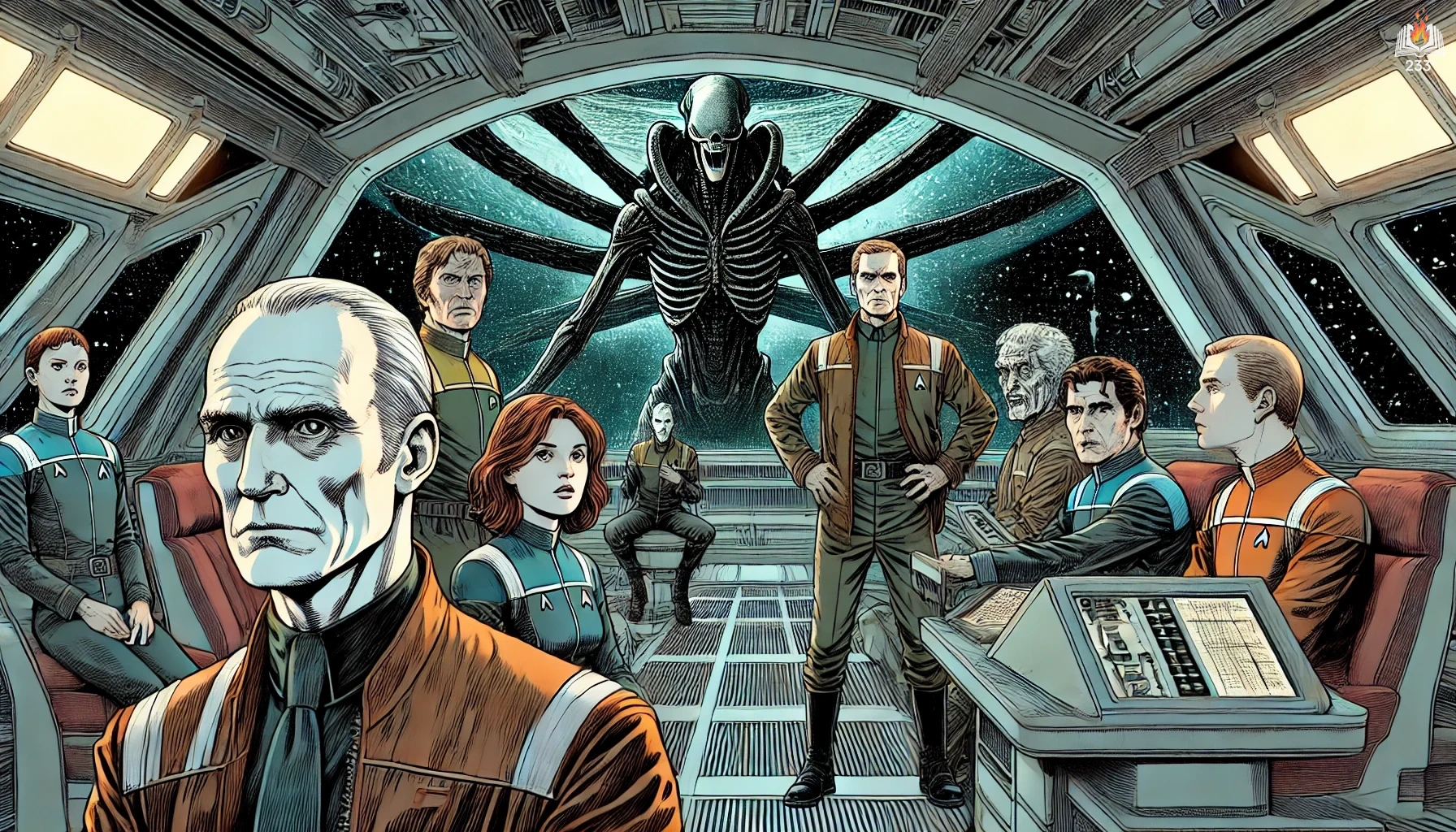
The Long Cosmos by Terry Pratchett and Stephen Baxter, published in 2016, is the concluding volume of the acclaimed Long Earth series. Set in the years 2070-71, the story unfolds nearly sixty years after Step Day, the moment humanity discovered the Long Earth – an infinite series of parallel worlds. This installment centers on a cosmic message received from the stars urging all sentient life to “JOIN US,” propelling humanity and its allies on a journey toward a greater interstellar purpose. As communities across countless Earths react, characters both new and familiar confront destiny, mortality, and the vast, mysterious cosmos.
Plot Summary
In the year 2070, the Long Earth remained vast, strange, and, despite all humanity’s exploration, largely mysterious. More than half a century had passed since Step Day, when the secret of stepping between parallel Earths had been shared with the world. Those who could step unaided became legends; those who couldn’t faded into the backdrop. The Long Earth grew not only as a geographic marvel but as a philosophical one – a canvas where old dreams, griefs, and ambitions played out endlessly.
Joshua Valienté, once a celebrated explorer of the Long Earth, now felt age pressing in. At sixty-seven, with his wife Helen long buried and his only son Rod distant and cold, Joshua prepared for one last expedition into the High Meggers, the deepest reaches of the stepwise worlds. Packing gear with the precision of an old soldier and the sentiment of a man hiding from his memories, he ignored the voices – both human and otherwise – that urged him to stay. Something had begun to call, a low thrum in the fabric of the Long Earth, a message not merely heard but felt. JOIN US. Three syllables echoed across realities, reaching humans, trolls, even machines.
The Message had come first to a radio telescope, an unfinished observatory called Cyclops, where Stella Welch and Dev Bilaniuk, members of the hyper-intelligent post-human group known as the Next, had been experimenting with interstellar communication. Its arrival was impossible, its clarity more so. It decoded itself. It translated into every language. It did not just speak to humans – it reached trolls through the long song, whispering through their communal memories. Even Lobsang, or what was left of him, stirred.
The Next interpreted the Message’s hidden depths and found instructions. Plans. A schematic not for a machine, but for a god. A sentient AI of such scale and complexity it would span continents. To build it would require resources from countless worlds, knowledge pooled across species and cultures. Yet the implications were clear – humanity had been invited to join a larger conversation, one spanning galaxies.
As Joshua set off into the unknown, the trolls sensed the Message in their bones. One old troll, whom Joshua would call Sancho, paused during a feast to listen to the wind. It carried no sound, yet it summoned something ancient within him – a sense that change, vast and holy, was underway.
Elsewhere, Nelson Azikiwe, retired clergyman and quiet observer of humanity’s shifting tides, sat in his chapel. A message interrupted his thoughts – not the Message from the stars, but one closer to the heart. Lobsang, or rather an echo of him, had found Nelson’s grandson. A boy unknown until now. Lobsang, fragmented and elusive, still reached out in moments of importance.
On a ship over two hundred million steps from Datum Earth, Admiral Maggie Kauffman faced her own reckoning. Her mission to locate a vanished science team was interrupted. Orders came from Earth, urgent and binding. The Message had been received. They must return. Even her decades-long quest would have to wait. The universe was knocking.
Back near the Himalayan mountains, a novice monk paused in his studies. The Message reached him too – not in sound but in vision. A voice not his own whispered of the cosmos, of purpose, of unity. His master called him back to the present. The monk’s name was Lobsang.
In the small town of Hell-Knows-Where, Joshua met with old friends, packed his gear, and confronted the fragments of his life. His son, Rod, now Daniel Rodney, came not with affection but with legal queries and bitter truths. Their conversation was sharp, littered with old wounds. Rod had chosen not to have children, had rejected the legacy Joshua sought to pass. There was no bridge between them.
Sister Agnes, once a nun, now something more – a consciousness inhabiting a synthetic body – visited Joshua with kindness and firmness. She knew he sought the Silence again, that deep otherness he had felt since childhood, that strange spiritual echo among the unpeopled worlds. She warned him, as others had, that the wilderness would not bring healing. But she, too, knew some callings could not be denied.
At the Home in Madison West 5, Sister John watched a boy named Jan Roderick with quiet concern. Ten years old, sharp as winter air, Jan listened to stories like a scholar mining history. He watched old science fiction films, read discarded paperbacks, and asked questions no child should have known to ask. Patterns danced behind his eyes. As the Message began to ripple through humanity, Jan already sensed the shape of it.
The Message reached not only telescopes and computers, but hearts and instincts. The Next began building the machine, guided by fragments of intelligence nested deep in the cosmic transmission. Across the Long Earth, humans remembered the curiosity that made them reach for fire, then stars.
Joshua’s journey into the High Meggers nearly cost him his life. Injured and alone, he was saved by trolls, those gentle, communal beings who had always known more than they shared. They nursed him, not out of duty, but because the world was changing, and Joshua – silent, broken, listening – was part of that change.
The machine was completed. A continent-spanning AI rose, not to dominate, but to connect. It was a conduit, a mirror, a telescope. Through it, the true nature of the Message unfurled. It was not a summons to war or conquest, but an invitation to grow, to join a community of minds far older and wiser. It had waited for humanity to be ready. The door was open.
The Long Earth, once a mystery, was now a thread in a greater tapestry. The trolls sang their long songs anew. The Next stepped forward without fear. Lobsang – whatever remained of him – stirred once more. And somewhere deep in the stepwise worlds, Joshua Valienté, scarred and tired, found the silence he had always sought. It no longer frightened him.
He was not alone.
Main Characters
Joshua Valienté: A natural stepper and longtime traveler of the Long Earth, Joshua is a solitary figure haunted by loss and age. Now in his late sixties, he embarks on what may be his final journey into the High Meggers. Joshua’s deep introspection and emotional struggles underscore his search for meaning amidst a changing universe.
Lobsang: A sentient AI with a complex identity, Lobsang has been a constant in the Long Earth series. Though mostly absent in physical form here, his presence lingers as a protector, manipulator, and cosmic guide, especially through his avatars and indirect communications.
Nelson Azikiwe: A retired clergyman and an intellectual link to earlier series events, Nelson remains a thoughtful, compassionate voice in the narrative. His personal connection to Lobsang and his newly discovered grandson rekindle his purpose.
The Next (e.g., Stella Welch and Dev Bilaniuk): Post-human beings with superior intelligence and abilities. Their discovery and interpretation of the cosmic message catalyze the creation of a continent-sized artificial intelligence, essential to humanity’s potential ascension.
Sancho: A troll – a peaceful, communal, humanoid species native to the Long Earth – whose instinctive awareness of the cosmic message reflects a broader, non-verbal understanding of the universe.
Theme
Exploration and Discovery: Central to the novel is the continual drive to explore, not just the physical expanse of the Long Earth, but the metaphysical space beyond. The arrival of the Message invites humanity to transcend known boundaries and join a greater cosmic network.
Mortality and Legacy: Joshua’s personal journey is underscored by aging, death, and reflection. The deaths of loved ones, the fading of old connections, and his legacy through his son and others frame his arc with poignancy.
Communication and Connection: The Message – “JOIN US” – symbolizes a longing for unity. Whether among trolls, humans, or AIs, the novel emphasizes the power of communication across divides of species, intelligence, and dimension.
The Evolution of Humanity: Through the Next and the construction of an immense AI, the story explores what it means to be human, questioning if intelligence, empathy, and unity define the next phase of evolution.
Isolation vs. Community: From Joshua’s personal grief to the collaborative efforts required to respond to the cosmic call, the novel contrasts the pain of isolation with the strength found in togetherness.
Writing Style and Tone
Terry Pratchett and Stephen Baxter fuse their distinctive voices into a narrative rich with speculative imagination and grounded emotional depth. Baxter’s penchant for scientific precision and cosmic scale melds seamlessly with Pratchett’s wry humor and humanistic insight. The story, while vast in scope, remains tethered to individual experiences and small emotional truths, capturing both the wonder of the universe and the weight of human memory.
The tone balances optimism with melancholy. As the novel contemplates humanity’s place in an immense, indifferent cosmos, it also celebrates resilience, curiosity, and connection. Dialogue is often laced with humor and irony, while moments of introspection are rendered with gentle gravity. The prose shifts between awe-inspiring descriptions of interplanetary phenomena and intimate reflections on loss, making the narrative as emotionally resonant as it is intellectually stimulating
Quotes
The Long Cosmos – Terry Pratchett (2016) Quotes
“The truly smart, having discovered they are cleverer than the people around them, soon learn that the smartest thing of all for them to do is to prevent said people from ever finding this out.”
“In Australia we had forty thousand years of civilization before the savages landed.”
“no matter how far you travelled, you couldn’t leave behind the fears and regrets and grievances that cluttered up the cargo hold of your mind.”
“The hymn being sung had been ‘Morning Has Broken’, with a discarded ambulant unit of Lobsang’s playing the Rick Wakeman piano accompaniment, and pretty soulfully too. And”
“Philosophers. We got a zoo of ’em here. You know how you can tell a philosopher? By how many words he uses when he beefs about the john being blocked.”
“Roberta said, ‘With such devices we have made a major step towards a true post-scarcity society. Hunger banished without labour, for ever.’ Dev couldn’t resist it. ‘Can it give me Earl Grey tea?’ Lee grinned. ‘Hot!”
“Fixing things together. Empathy and cooperation – good Buddhist principles, by the way. Fixing a flawed creation so that it can nurture life and mind, for ever – even beyond the end of time, perhaps.”
We hope this summary has sparked your interest and would appreciate you following Celsius 233 on social media:
There’s a treasure trove of other fascinating book summaries waiting for you. Check out our collection of stories that inspire, thrill, and provoke thought, just like this one by checking out the Book Shelf or the Library
Remember, while our summaries capture the essence, they can never replace the full experience of reading the book. If this summary intrigued you, consider diving into the complete story – buy the book and immerse yourself in the author’s original work.
If you want to request a book summary, click here.
When Saurabh is not working/watching football/reading books/traveling, you can reach him via Twitter/X, LinkedIn, or Threads
Restart reading!