Tell-All by Chuck Palahniuk, published in 2010, is a darkly satirical novel drenched in the glamour, gossip, and grotesquerie of Old Hollywood. Set against the backdrop of fading stardom and manufactured comebacks, the novel follows an aging film actress and her fiercely loyal caretaker as they navigate a world of opportunistic lovers, lethal secrets, and the threat of literary exploitation. Palahniuk’s trademark blend of shock, humor, and cultural critique is on full display as he dissects fame, identity, and obsession with a razor-sharp narrative voice.
Plot Summary
In the twilight world of celluloid queens and lavender memories, Katherine Kenton reigns supreme – not in present glory, but in carefully curated decay. Her satin-draped boudoir pulses with the afterglow of bygone stardom, her every breath perfumed with Chanel No. 5 and whispered regrets. Around her orbits Hazie Coogan, the ever-watchful architect of Kathie’s delusions, a loyal companion whose hands scrub floors by morning and scribble legacy by night. Hazie knows the real woman beneath the wigs and velvet, the trembling monument propped up by corsets and denial, and she alone ensures the illusion endures.
Then comes the dinner party, a circus of aging aristocrats and reanimated gossip. Amid the smoke and soufflés, a young man appears like a telegram from the future – bright brown eyes, symmetrical cheekbones, and the smooth patter of someone who’s practiced sincerity in the mirror. His name is Webster Carlton Westward III. He arrives at the edge of the table like a comet skimming the galaxy of has-beens and barely-still-ares. His smile is half-devotion, half-devour.
Hazie, whose eyes have cataloged every opportunist since the Eisenhower administration, marks him instantly. But Miss Kathie, high on flattery and half-remembered dialogue, is too dazzled to see the wolf beneath the tuxedo. Flowers arrive. Notes follow. Westward oozes into their lives like a stain on satin. He speaks in sonnets, in Gatsby-grade sentiment. He courts her with Jordan almonds and dinner invitations, signing every bouquet like a contract.
The whispers begin to rise, not from the tabloids but from the manuscripts. Webster, it turns out, is an author in embryo. A tell-all in waiting. The kind of man who ghosts around fireplaces and pours brandy while collecting confessions. The kind who kisses hands and records secrets. His past is paper trails and secondhand stories. What he wants isn’t love – it’s legacy. Katherine Kenton’s legacy.
Hazie isn’t merely alarmed. She’s activated. Protecting Miss Kathie isn’t an obligation, it’s religion. Westward must be stopped, preferably before he finishes the chapter on her death. The evidence comes subtly – a sugar cube too sweet, a bonbon too deadly. Loverboy, Kathie’s little Pekingese, collapses beside a heart-shaped box of chocolates. Hazie watches the dog twitch and fade, like a prelude. Then come the flowers again, too fragrant to be sincere, and the suspicious letter inviting Kathie to dinner. The date reads Saturday. Hazie, ever the director, rewrites it to Friday.
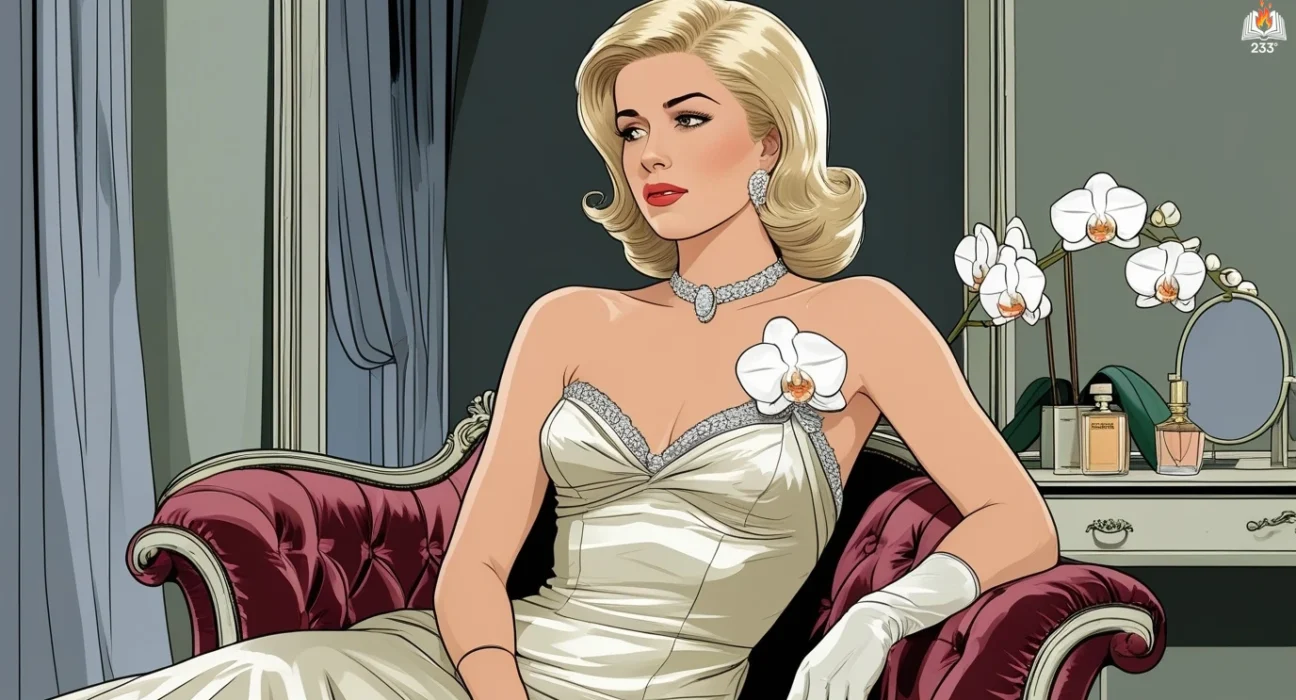
The trap is not dramatic. It’s divine. Kathie will dress to kill – or to be killed. The satin gown arrives. The wig, freshly styled. The corsage – orchids, of course – pinned just right. Eight o’clock comes. Eight-thirty follows. Kathie sips scotch, swallows pills, tears the orchids to ribbons. By midnight, she is slouched in faded grandeur, lipstick bleeding into the corners of her mouth, waiting for a man who never planned to arrive.
But he would have. Just not tonight.
Hazie’s victory is quiet, almost ceremonial. The letter burns. The flowers rot in alleyways. When Westward calls, she answers as an institution for criminally reckless women and hangs up. When he visits, he’s met with locked doors and forged notes. He becomes another ghost among the many who’ve passed through Kathie’s love life – the failed actor, the steel tycoon, the Latin brain surgeon. All were cast, none endured.
And yet Kathie, eternal mistress of reinvention, begins her resurrection. She dyes her hair. She shaves her legs. She starves herself into a silhouette. All signs point to a new romance, perhaps another mistake. Hazie prepares the town house for another performance – drapes drawn, bed fluffed, whiskey chilled. Each scene is a movie waiting to be filmed. The white sable retrieved. The gown steamed. The high heels polished to glint under candlelight.
But Hazie’s real masterpiece lies not in preserving Kathie’s dignity, but in curating her suffering. Every telegram of sympathy is intercepted and flushed. Every condolence shredded. Kathie believes the world has forgotten her, that even her former husbands have abandoned her. She weeps, purges, withers – all while Hazie watches from the wings, rewriting reality one forged letter at a time.
And yet, something cracks. Webster returns, not in apology, but in persistence. The flirtation resumes, veiled now in hints and shadows. Kathie accepts the bouquet this time. She tucks her diaphragm into her coat pocket and flutters her lashes like a schoolgirl. Hazie shakes her head, a warning lost to the perfume haze of infatuation.
The days repeat in ritual. Deliverymen arrive with armfuls of florals. Hazie intercepts each bouquet, poisons the water with bath salts. The petals brown before Kathie can admire them. Every card signed in Westward’s hand is steamed open, forged, or destroyed. The love letters are copied, the rendezvous rescheduled to days when Westward never comes. Hazie erases their connection before it can solidify, careful to preserve Kathie’s legend but never her happiness.
She cannot allow Kathie to be immortalized in someone else’s version of the truth.
The house becomes a mausoleum of stifled affection. Cards pile up, torn and drowned. Phone calls redirected to silence. Hazie’s fingers bleed from clawing secrets out of clogged pipes. And still, Miss Kathie prepares herself for each new heartbreak, pressing Vaseline over her teeth, practicing smiles in triple-mirrored reflection.
Time, like film, loops. The plot winds back again. The dressing gown. The screenplays on the nightstand. The empty glasses. The buzz of an alarm clock. Eight o’clock again, and again. Until the night when Hazie assembles it all – wig, corsage, gown – like a set piece for an encore that will never play. Westward isn’t coming, but Kathie doesn’t know that yet.
At the last moment, Hazie kills the clock.
And outside, in the quiet corridor of a dream or memory, the scent of spoiled roses clings to the air, thick with perfume and regret. Kathie lies in wait, radiant and ruined. And Hazie, high priestess of image and deception, stands in the wings, her work complete.
Main Characters
Hazie Coogan: The narrator and de facto protagonist, Hazie is the longtime caretaker, manager, and manipulator behind the dazzling public image of film legend Katherine Kenton. Sarcastic, perceptive, and scathingly witty, Hazie operates more as a puppet master than a maid. Her internal commentary drives the narrative as she meticulously controls every aspect of Kathie’s life – from her outfits to her romances – with calculated precision. Though she presents herself as dispassionate and dutiful, her actions betray a deeply possessive and possibly destructive devotion.
Katherine “Miss Kathie” Kenton: Once a screen goddess, now a relic of bygone fame, Kathie lives in self-imposed theatrical grandeur. Vain, insecure, and obsessed with reclaiming her past stardom, she is a tragicomic figure steeped in faded glamour and melodrama. Her repeated reinventions, doomed romances, and addiction to cosmetic illusion make her both pitiable and emblematic of Hollywood’s toxic mythology. Despite her outward fragility, Kathie still clings to her persona with fierce resolve.
Webster Carlton Westward III: A suspiciously charming young man who enters Kathie’s life with a bouquet and an agenda. His polished manners and romantic gestures mask a parasitic intent: to write a scandalous biography upon Kathie’s death. His calculated courtship ignites Hazie’s paranoia, prompting her to launch a secret war to protect her muse from being turned into a posthumous spectacle. He serves as both antagonist and victim in the narrative’s twisted chess game.
Lillian Hellman (fictionalized version): Though not central to the main plot, the satirical portrayal of Hellman as an outrageous, name-dropping braggart appears throughout as an avatar for ego-driven myth-making. She becomes a grotesque caricature of those who reshape history for their own glory, functioning as a foil to Hazie’s own storytelling.
Theme
The Manufactured Nature of Fame: Palahniuk skewers the illusion of celebrity, exposing the artifice behind every performance, public appearance, and romantic entanglement. Through Hazie’s backstage efforts to maintain Kathie’s image, the novel reveals how fame is a product of manipulation, denial, and narrative control rather than genuine achievement.
Control and Obsession: At its heart, the novel is a psychological battle of control. Hazie’s obsessive grip on Kathie’s life borders on tyrannical, masking deep co-dependency and fear of obsolescence. The struggle between Hazie and Westward becomes a war of influence – one wields loyalty and legacy, the other love and lies.
Aging and Mortality: The fear of growing irrelevant or being forgotten permeates the story. Kathie’s cosmetic rituals and her shrine-like home underscore her resistance to decay, while Hazie’s actions hint at a desperation to preserve their world exactly as it is, regardless of the cost.
Narrative as Weapon: The concept of the “tell-all” memoir becomes a metaphor for betrayal and manipulation. Palahniuk explores how stories can be tools of power, revenge, and preservation, whether it’s Westward’s future exposé or Hazie’s own filtered retelling of events.
Writing Style and Tone
Palahniuk’s prose in Tell-All is intentionally theatrical, adopting the diction and rhythm of classic Hollywood screenplays. The book reads like a cinematic script filtered through the dry sarcasm and acidic wit of its narrator. Scene headers such as “ACT I, SCENE ONE” set the stage, blurring the line between performance and reality. The syntax is stylized – rapid, clipped, and filled with era-specific references that evoke both nostalgia and absurdity.
The tone is caustic yet strangely affectionate. Palahniuk crafts Hazie’s voice with biting irony, but it’s tinged with genuine emotion and fierce protectiveness. Her perspective swings between scorn and reverence, highlighting the blurred boundaries between love, loyalty, and possession. This tonal ambiguity gives the novel its unsettling emotional undertow beneath the surface satire.
The narrative is laced with hyperbole, over-the-top metaphors, and name-dropped celebrities—real and fictional—often used as punchlines or cultural shorthand. The effect is dizzying, like being caught in the monologue of a gossip columnist on amphetamines. Through this exaggerated lens, Palahniuk critiques not just celebrity culture but the compulsion to mythologize, archive, and consume the lives of others.
Quotes
Tell All – Chuck Palahniuk (2010) Quotes
“All human beings search for either reasons to be good, or excuses to be bad.”
“I suppose it’s comfort, perhaps a sense of self-control, doing worse things to yourself than the world will ever dare inflict.”
“In truth, the degree of anyone's success depends on how often they can say the word yes and hear the word no.”
“I disconnect the telephone to keep the outside world in it's correct place.”
“There's worse that people can steal from you than money.”
“His saliva tasted like the wet dicks of ten thousand lonely truck drivers.”
“No, none of us seem so very real. We're only supporting characters in the lives of each other. Any real truth, any precious fact will always be lost in a mountain of shattered make-believe.”
“If it is the case that love does survive death, then you may consider this to be a happy ending. Boy meets girl. Boy gets girl. Happily ever after or not.”
“Lovely, forgettable faces, born to flirt and fuck and die.”
“Optimism is the first symptom that any disease is fatal.”
“Katherine Kenton remains among the generation of women who feel that the most sincere form of flattery is the male erection.”
“A baby is such a blank slate, like training the understudy for a role you're planning to leave. You truly hope your replacement will do the play justice, but in secret you want future critics to say you played the character better.”
“A salacious lie will always trump a noble truth.”
“We hear the ambient noise of children singing. We hear lions and tigers roar. Hyenas laugh. Some jungle bird or howler monkey declares its existence, screeching a maniac's gibberish. Our entire world, always doing battle against the silence and obscurity of death.”
“In truth, the degree of anyone's succes depends on how often they can say the word 'yes' and hear the word 'no.' Those many times you are thwarted yet persevere.”
“The career of a movie star consists of helping everyone else forget their troubles. Using charm and beauty and good cheer to make life look easy.”
“Each wedding picture was less of a memento than a scar. Proof of some horror movie scenario Katherine Kenton has survived.”
“Perhaps life itself occurred as a sort of prison she felt compelled to escape.”
“The moment the world declares a person to be immortal, at that moment the person will strive to prove the world wrong”
“Everything sounds so much better when it comes out of a man's mouth”
“This wasn't any mere song and dance; here was a bold, blaring declaration howling itself into the empty face of death.”
“The problem is, if you never weep in public... well, the public assumes you never weep.”
“When we remember someone as a drunk, a liar, a bully, we're only creating an excuse for our own poor behavior.”
“No memory is anything more than a personal choice.”
“Each romance, the type of self-destructive gesture Hedda Hopper would call "marry-kiri".Instead of plunging a sword into one's stomach, you repeatedly throw yourself on the most inappropriate erect penis.”
“Based on decades of observation, I propose that sudden high levels of praise always trigger an equal amount of inner self-loathing.”
“We all have some proper noun to blame.”
“All humans search for either reasons to be good or excuses to be bad.”
We hope this summary has sparked your interest and would appreciate you following Celsius 233 on social media:
There’s a treasure trove of other fascinating book summaries waiting for you. Check out our collection of stories that inspire, thrill, and provoke thought, just like this one by checking out the Book Shelf or the Library
Remember, while our summaries capture the essence, they can never replace the full experience of reading the book. If this summary intrigued you, consider diving into the complete story – buy the book and immerse yourself in the author’s original work.
If you want to request a book summary, click here.
When Saurabh is not working/watching football/reading books/traveling, you can reach him via Twitter/X, LinkedIn, or Threads
Restart reading!